
What Evidence-Based Farriery Actually Means — and Why It Matters More Than You Think
By Mark N. Caldwell PhD FWCF & Neil Madden FWCF
From The Equine Foot: Science, Craft & Clinical Reasoning in Farriery and Podiatry·
A 14-year-old sport horse. Early coffin joint remodelling. Mild palmar osteochondrosis. A veterinarian turning to you mid-consultation and asking: “What is your evidence base for the trim and shoe you are proposing?”
You have used this intervention for twenty years. It works. You have seen it work. But can you articulate why — and can you tell the owner precisely where that knowledge comes from?
It is not hypothetical. It is a clinical reality that working farriers are increasingly encountering — and will encounter more often as the profession continues its trajectory toward full clinical professionalisation in the Craft, and Clinical Reasoning in Farriery is becoming the new norm.
The Profession Has Changed. Have You?
Farriery is one of the oldest crafts associated with the horse. For most of recorded history, its knowledge passed from master to apprentice in the most literal empirical tradition — accumulated observation, transmitted by demonstration, refined by consequence. There were no textbooks. No curricula. No formal distinction between the man who shod horses and the man who treated them.
That world is gone. And while there is much worth preserving in the craft tradition — the hands-on skill, the pattern recognition, the embodied knowledge of a hoof under your hands — the professional context in which that craft now operates has been transformed.
Three forces drove the transformation. First, the rise of equestrian sport from the 1950s onward created a horse population competing at intensities that exposed subtle biomechanical vulnerabilities. Second, a new owner community emerged — people who expected to understand what was happening to their animals, and who expected practitioners to explain it. Third, equine veterinary science became a genuine research discipline from the 1960s onward, generating peer-reviewed literature on musculoskeletal anatomy, biomechanics, and pathology that intersected directly with farriery decisions.
“The question is no longer whether the profession will become more evidence-oriented. The question is how quickly individual practitioners will equip themselves to meet the expectation that is already here.”
The farriers working at the highest levels of equine sport today are expected to understand imaging reports, communicate using shared clinical terminology with veterinary surgeons, and maintain records that could withstand professional scrutiny. These are not aspirational standards. They are current expectations. And they are reflected in the competency frameworks of the Worshipful Company of Farriers, the American Farriers’ Association, and — increasingly — in sport horse licensing regimes and equine insurance policy conditions.
The Three-Legged Stool: What EBP Actually Requires
Evidence-based practice was defined in its foundational medical literature by Sackett and colleagues in 1996 as the conscientious, explicit, and judicious use of current best evidence in making decisions about the care of individual patients. That definition translates directly to farriery. Each of its three adjectives matters.
- Conscientious: it requires active engagement, not passive familiarity with received wisdom
- Explicit: the practitioner should be able to state what evidence they are using and why
- Judicious: evidence requires judgement — it cannot be applied mechanically to a living animal in a complex clinical context
The model that Sackett’s group proposed — and which this book builds on directly — rests on three components that must integrate in every decision:
1. Best available research evidence — current peer-reviewed studies on interventions and outcomes, properly appraised and weighted. Not necessarily randomised controlled trial evidence — in farriery, that standard would bring clinical practice to a standstill. The best evidence that currently exists. 2. Clinical expertise — the farrier’s accumulated pattern recognition, hands-on assessment capability, and case experience. This is not a concession to anti-science sentiment. It is a structural component of the model. Research tells you what worked on average, across a study population. Your expertise tells you whether this horse, today, fits that population closely enough for the evidence to apply. 3. Patient values and context — the individual horse’s breed, workload, footing, history, and the owner’s goals. Evidence guides the decision. The individual case determines it. |
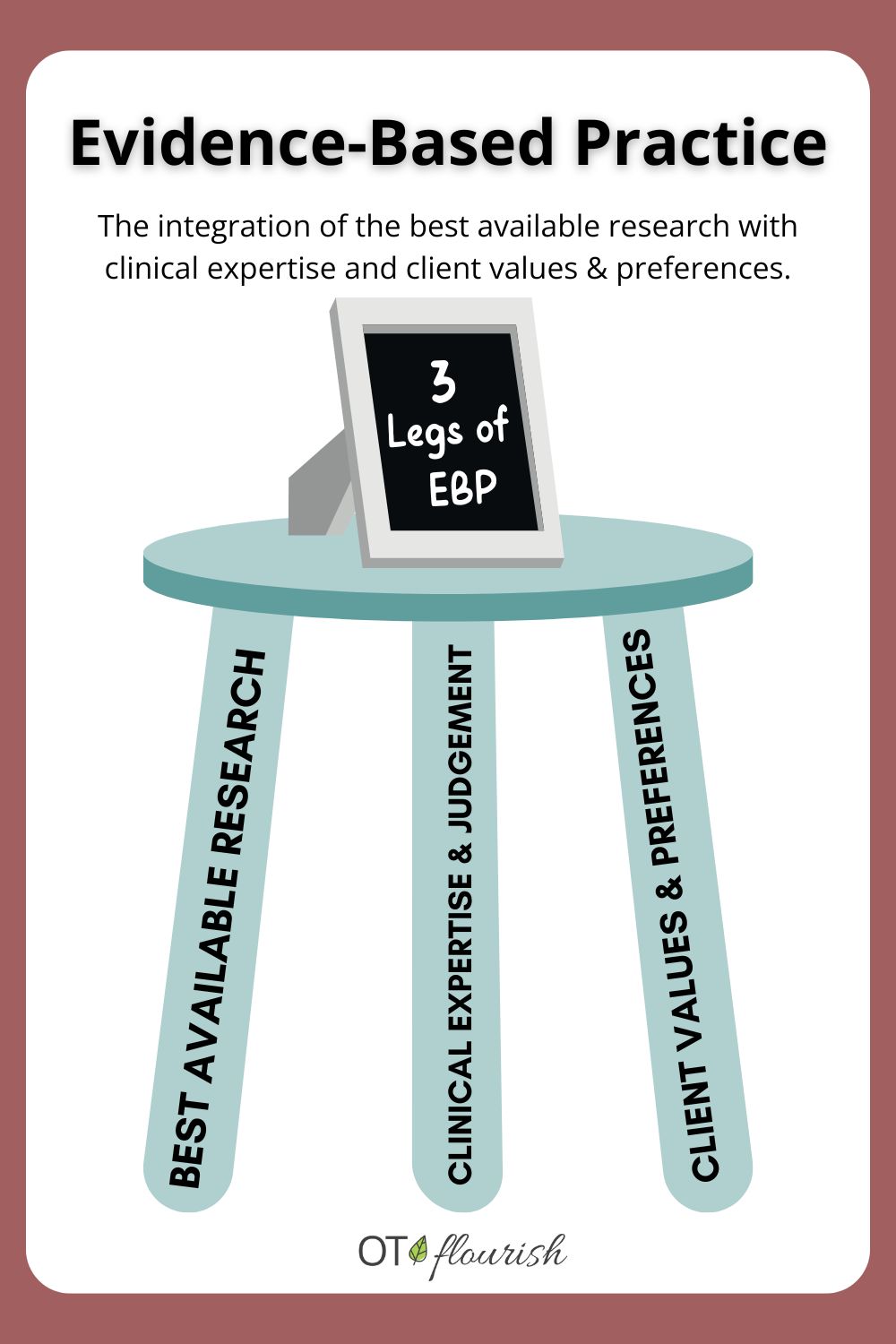
3 legged stool of EBP
The three-legged stool is not always in balance — and the farrier’s judgement lies in knowing which leg is bearing most of the weight at any given clinical moment. For routine maintenance of a well-balanced horse, tradition and experience are appropriate primary guides. For a horse with progressive palmar foot syndrome in a competition context, the balance shifts heavily toward published evidence on therapeutic shoeing outcomes.
Knowing which situation you are in — recognising when the evidence leg needs to bear more weight, and when it doesn’t — is itself a clinical skill that this book is designed to develop.
The Four Evidence Grades: A Transparency System, Not a Permission Hierarchy
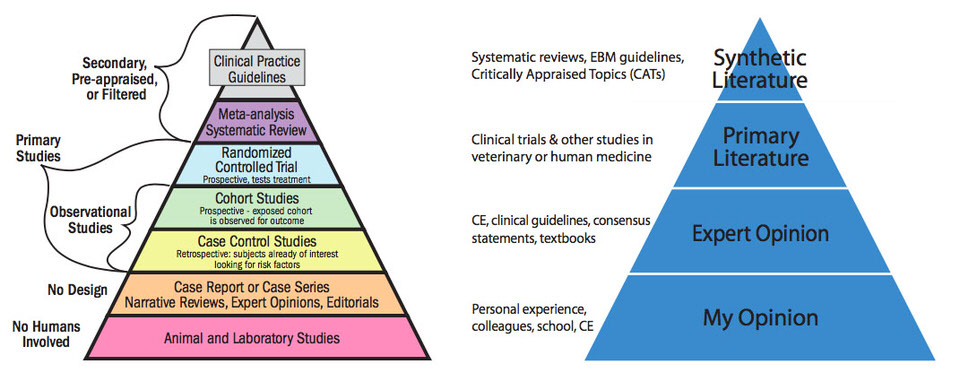
One of the distinctive features of The Equine Foot is that every significant clinical claim carries an evidence grade — a marker that tells the reader what kind of knowledge underlies the recommendation. Four grades are used throughout the process:
- [RCT] — Randomised controlled trial. The highest grade. Rare in equine research because of the practical, ethical, and methodological constraints involved, but cited explicitly where it exists.
- [CS] — Consensus or systematic review. Aggregated and critically appraised evidence from expert panels and systematic literature reviews. Includes AAEP consensus statements and Equine Veterinary Journal supplements.
- [EX] — Expert opinion and clinical experience. Peer-reviewed descriptive studies, case series, and published clinical authority. The most common grade in this book — and not a weak grade. In farriery, much of the working evidence base sits here.
- [TR] — Traditional practice. Longstanding clinical convention without formal experimental validation. A transparency marker, not a dismissal. When you are working from tradition, you should know it.
These grades are transparency tools, not a hierarchy of permission. A [TR]-graded intervention can still be the right clinical choice if there is a sound mechanistic rationale and no contradicting evidence. A [RCT]-graded finding still needs to be read critically — the study population may not match this horse.
What the grades prevent is the most dangerous clinical habit: the practitioner who recommends an intervention without knowing what kind of knowledge it rests on. The inability to distinguish between a well-designed prospective study and fifty years of tradition is not clinical neutrality. It is a form of intellectual negligence that, as we will see, carries measurable consequences.
When Farriery Standards Fail, Horses Pay the Price
This article makes an argument that some practitioners find uncomfortable, and which the book deliberately does not soften: the epidemiological link between farriery standards and catastrophic musculoskeletal injury is established in the peer-reviewed literature.
Anthenill and colleagues, writing in the American Journal of Veterinary Research in 2007, identified farriery-related factors — including asymmetric hoof angle and delayed breakover — as independent risk factors for proximal sesamoid bone fracture in Thoroughbred racehorses. The adjusted odds ratios were clinically significant: horses with hoof angle asymmetry of three degrees or more between forefeet had substantially elevated fracture risk compared to symmetrically balanced horses. This was a multivariable analysis on a large racing population with detailed farriery records. The study design controls for confounders. It is [CS]-grade evidence.
Hennessy and colleagues extended these findings in 2021, in a prospective study of Standardbred trotters published in the Equine Veterinary Journal. Their design strength is specific and worth noting: hoof balance parameters were measured at each shoeing interval. The farrier’s decision at every cycle becomes a tracked, accountable variable in an injury outcome model. Balance is not a cosmetic consideration. It is a structural risk factor with measurable outcome consequences.
“Ignorance does not reduce liability — it increases it, because it removes the possibility of informed risk assessment.”
The professional responsibility argument that the article draws from this evidence is direct: a farrier who does not understand the evidence base cannot exercise the clinical judgement the evidence demands. And the regulatory frameworks are catching up. WCF higher-level competency requirements now explicitly reference clinical reasoning and evidence interpretation. Sport horse licensing regimes in several jurisdictions specify farriery standards as conditions of competition entry. The direction of travel is not ambiguous.
Shared Language: The Farrier’s Place at the Clinical Table
The farrier is the only non-veterinary professional holding a licensed, regulated, and direct therapeutic role in managing equine musculoskeletal health. Studies examining outcomes in horses with palmar foot pain, laminitis, and post-surgical foot conditions consistently identify the farriery intervention as a primary determinant of prognosis. This finding cuts in both directions: it argues for the farrier’s clinical importance, and it argues for the standard of knowledge and communication the role demands.
Effective collaboration with the veterinary surgeon begins with shared language. A farrier who describes a horse as ‘long in the toe’ is communicating something clinically meaningful. A farrier who can specify the dorsal wall angle, the palmar angle of the distal phalanx relative to the ground surface, and the relationship between the centre of articulation and the breakover point is doing something different: they are participating in a shared clinical framework that admits of comparison, tracking, and peer review across professionals and over time.
IN PRACTICE writing a clinical shoeing record makes the point with unusual directness. A clinical record — date, horse identification, presenting condition, veterinary briefing received, hoof measurements, shoe type and modifications, adjuncts applied, clinical observations, planned review date — is not bureaucratic overhead. It is the document that allows a vet to verify that therapeutic instructions were followed, that allows the farrier to track whether a foot is improving or deteriorating, and that provides professional protection if a dispute arises.
| “The farrier who keeps no records beyond the invoice is not simply behind the curve. They are accumulating clinical liability.” |
This is not a comfortable sentence. It is an accurate one. And it is a sentence that, by the end of this book, practitioners will have the knowledge to ensure they never need to hear said about them.
What This Article Is, and What Comes Next
This article establishes the why. Why evidence matters. Why the profession has changed and will continue to change. Why a shared clinical language with veterinary surgeons is not optional for practitioners working at any serious level. Why the farrier’s records are clinical documents. In a subsequent article we will discuss the thinking framework: the five-stage clinical reasoning model and the Integrated Locomotor System — a conceptual tool that treats the equine limb from hoof wall to thoracolumbar junction as a continuous mechanical chain in which forces, postures, and pathologies propagate in both directions.
References
- Sackett DL, Rosenberg WMC, Gray JAM, Haynes RB, Richardson WS. Evidence based medicine: what it is and what it isn’t. BMJ. 1996;312(7023):71–72.
- Hennessy SE, Malm C, Olsson E, et al. Associations between hoof balance and injury in Standardbred trotters. Equine Vet J. 2021;53(3):477–485.
- O’Grady SE, Poupard DA. Physiological horseshoeing: an overview. Equine Vet Educ. 2003;15(6):325–332.
- Anthenill LA, Stover SM, Gardner IA, Hill AE. Risk factors for proximal sesamoid bone fractures associated with exercise history and horseshoe characteristics in Thoroughbred racehorses. Am J Vet Res. 2007;68(7):760–771.