
The Ground Beneath Their Feet – Artificial Surfaces, Biomechanics, and the Farrier’s Response
Mark N. Caldwell PhD., FWCF. HoofFlix, 116, Newcastle Road, Talke, Staffordshire. ST71SA. UK
Email: info@hoofflix.com
10–14 minute read ● Topics: Surface Science · Biomechanics · Shoeing Protocol ● Audience: Farriers – Owners
The proliferation of artificial and engineered arena surfaces across performance horse sport has been one of the most significant environmental shifts in equine management of the past three decades. Polytrack, fibre-sand synthetics, rubber-crumb composites, waxed all-weather racing surfaces — these substrates are now the daily working environment for millions of horses globally. Yet the farriery community’s response to this shift has remained largely intuitive, anecdotal, and inconsistent. This article argues that understanding how artificial surfaces behave mechanically, and what that behaviour does to the distal limb, should be a core competency for any farrier working with performance horses — and that our shoeing decisions need to reflect that understanding explicitly.
What Does a Surface Actually Do?
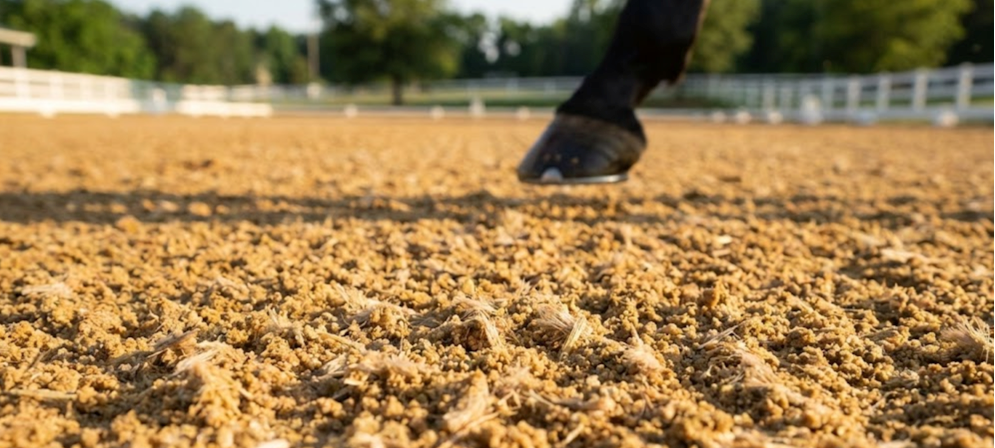
It is easy to think of the surface as a passive backdrop — simply the thing the horse stands on. The science tells a different story. The surface is an active participant in the biomechanical event of each hoof contact. It determines how quickly the limb decelerates at landing, how much energy is returned to the limb during stance, how far the hoof sinks, and how much it slides. Change the surface, and you change all of those variables — whether or not you change anything about the shoe.
Surface science identifies five functional properties that govern this interaction. Hardness (or firmness) determines the rate at which ground reaction force (GRF) rises at impact. Energy restitution describes how much of the kinetic energy absorbed at landing is returned to the limb — a surface with high energy restitution acts like a spring; one with low restitution absorbs the energy and dissipates it as heat. Shear strength governs resistance to horizontal forces — the surface’s grip. Consistency describes how uniform these properties are across the working area. And water content acts as a modulating variable across all four: almost no surface property is independent of moisture.
⚙ BIOMECHANICS PRIMER — Why Rate of Loading Matters
When a hoof contacts the ground, GRF rises from zero to peak (typically 1.0–1.5× bodyweight at trot, higher at canter and gallop) within milliseconds. The rate at which it rises — the loading rate — is a critical injury variable. Bone responds to slowly applied loads with remodelling and adaptation. Bone subjected to rapidly applied loads, before adaptive processes can keep pace, accumulates microdamage. This is the core mechanism behind dorsal metacarpal disease (bucked shins) and stress fracture in young racehorses: not the peak force itself, but the rate at which it arrives. Hard surfaces increase loading rate. This is not controversial — it is one of the best-evidenced relationships in equine surface science.
Soft tissue injury follows a different but related logic. The deeper the hoof sinks into the surface at mid-stance, the further the fetlock dorsiflexes. Peak fetlock dorsiflexion directly determines peak SDFT strain. A surface that is soft enough to allow excessive sinkage — over-watered sand, a deep synthetic in poor maintenance — is therefore a soft tissue injury risk, even though it feels “kind” on the foot. The surface can simultaneously be kind to bone and unkind to tendon. This tension is at the heart of surface management.
The Five Surfaces Your Clients Are Using — and What They’re Actually Doing
Waxed Sand-Fibre Synthetic (Polytrack / Tapeta type)
These surfaces combine silica sand with synthetic fibre and a wax binder. When maintained and at operating temperature, they deliver moderate hardness, good energy restitution, moderate shear strength, and — their key distinguishing feature — very high consistency. The published evidence from Setterbo et al. (2009) showed that GRF impact characteristics on synthetic surfaces differed significantly from dirt. Crevier-Denoix et al. (2009) provided the most direct in vivo evidence of SDFT loading: using surgically implanted force transducers in trotting horses, they demonstrated that SDFT loading on waxed track was lower and more gradually applied than on crushed sand. This is a meaningful finding for arenas, not just racing.
The temperature problem is critical and often overlooked in farriery practice. Bridge et al. (2010) demonstrated that the triaxial shear strength of waxed synthetic surfaces changes significantly with temperature. A surface that is compliant and well-gripped in summer can become hard and slippery in January. The horse on a cold morning in an indoor arena is working on a fundamentally different surface to the horse working at afternoon temperatures — even if nothing else has changed.
Rubber-Crumb Composite
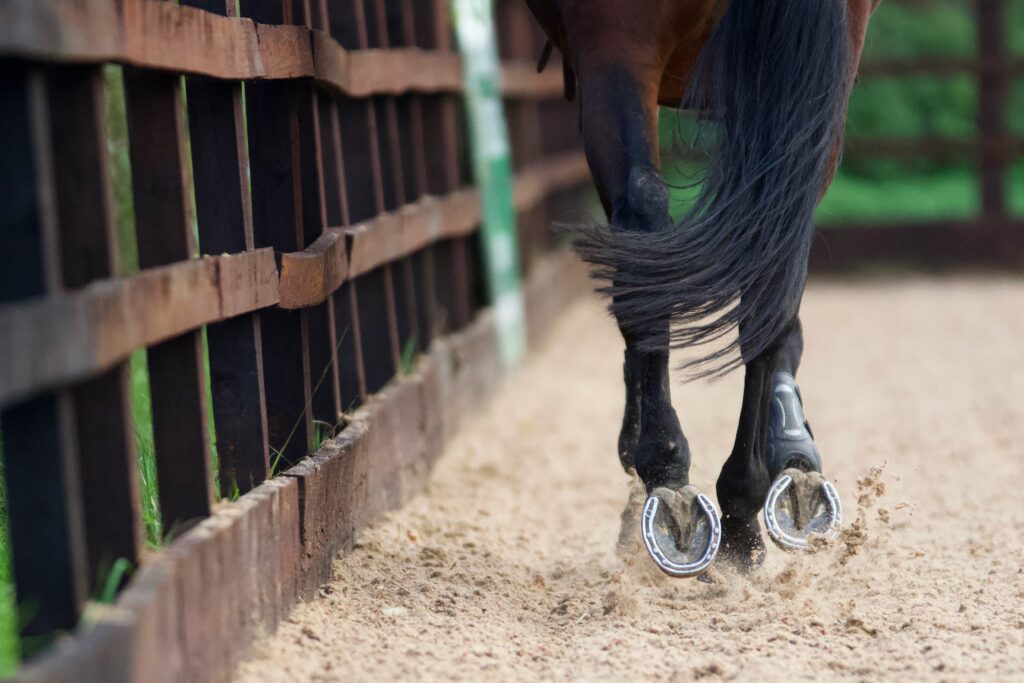
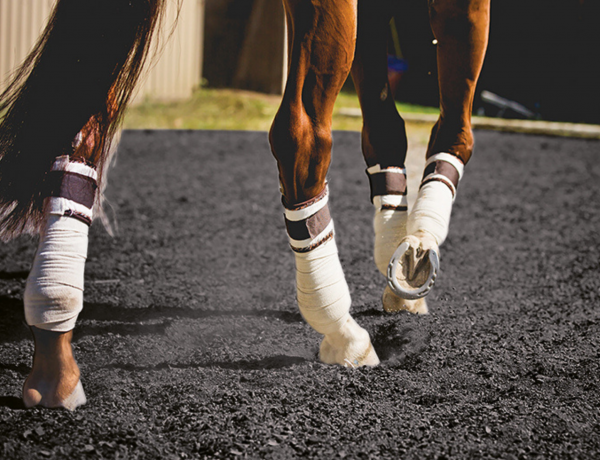
Rubber-crumb arenas are increasingly common in elite dressage facilities. Their mechanical profile reflects this: low-to-moderate hardness, moderate energy restitution, moderate shear strength, good moisture independence. Rohlf et al. (2023) provided quantitative characterisation of shear GRF differences across arena surfaces, confirming that rubber surfaces deliver a different horizontal force environment to sand and synthetic alternatives.
Here is a concept that deserves serious discussion in practice. The rubber composite surface has a relatively high inherent coefficient of friction and is also deformable. This sounds ideal. The problem is that natural craniocaudal slip at landing is a protective mechanism. Pardoe et al. (2001) demonstrated elegantly that hoof slip at landing dissipates energy over a longer time period, reducing peak impact forces transmitted to the limb. A surface that absorbs energy and also prevents slip may be reducing impact GRF while simultaneously increasing rotational loading on the fetlock at landing — in effect, substituting one injury mechanism for another. This is a mechanistic hypothesis, not a proven fact — but it is the kind of reasoning that should inform our traction decisions on rubber arenas.
Sand Arenas — Plain, Fibre-Modified, Rubber-Augmented
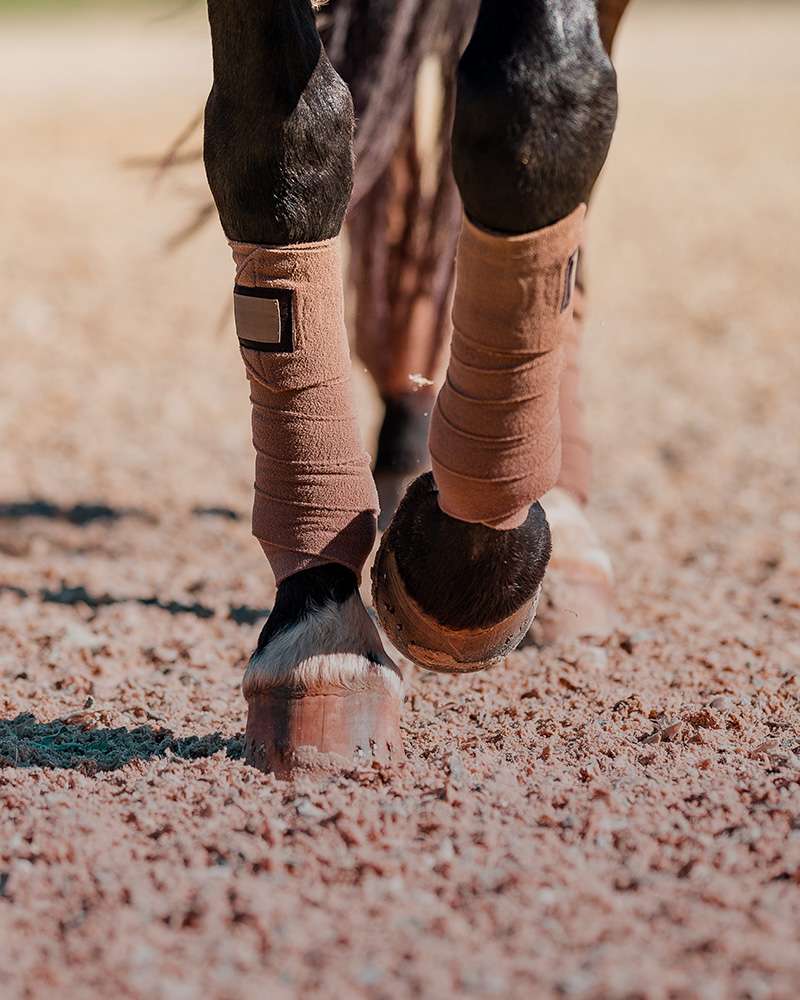
Sand’s mechanical properties are highly variable: particle size, depth, moisture content, and the presence or absence of fibre or rubber modifiers all substantially alter its behaviour. Dry, loose sand is low in hardness, very low in energy restitution, and very low in shear strength. The principal injury risks from sand for sport horses are well-established in principle if not in hard data. Excessive depth drives the fetlock into deeper dorsiflexion at mid-stance, elevating SDFT and suspensory ligament (SL) strain. Murray et al. (2006) documented that advanced dressage horses showed elevated hindlimb SL injury rates compared with other disciplines — a finding that sits logically with the loading demands of collection on a yielding surface.
Cross-Country and Natural Ground
Cross-country eventing presents the most uncontrollable surface environment in equine sport. The horse encounters firm-going on approach, soft ground at take-off or landing, hard compacted paths between fences, and potentially saturated going at lower points of the course — sometimes within a single jumping effort. Singer et al. (2008) documented injury patterns at three-day events, identifying surface-related risk factors. The epidemiological signal is clear: the cross-country surface environment is a significant injury modifier.
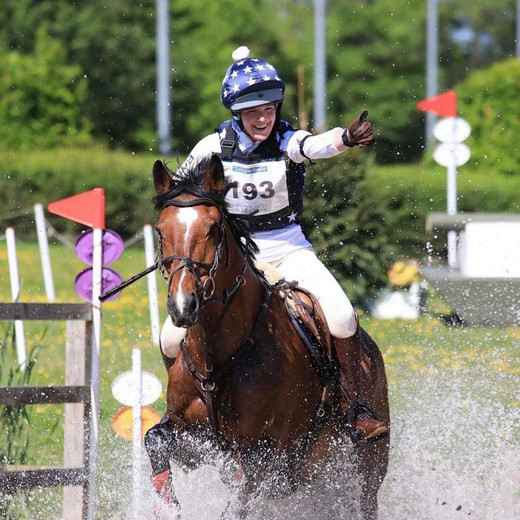
“The shoe does not work in isolation. It works within a shoe-surface system. And the properties of that system are jointly determined by both elements. Change the surface, and the shoe’s effective behaviour changes — even if you haven’t touched it.”
What the Evidence Actually Tells Us About Shoe-Surface Interaction
The racing world has given us most of our hard evidence here. Mahaffey et al. (2016) compared racing shoe designs at controlled impact on two surface types, demonstrating that the mechanical response varied substantially by surface as well as by shoe. Horan et al. (2021, 2022) went further, measuring the effects of eight shoe-surface combinations on hoof acceleration and breakover duration in galloping Thoroughbreds. Their finding is important for everyone working with sport horses: shoe geometry significantly influences breakover duration, but this effect is modified by the surface. The shoe you fit changes how the horse leaves the ground — but the surface changes how much difference the shoe makes.
On natural slip at landing, Pardoe et al. (2001) demonstrated that shoe material and surface finish both influence slip kinematics. Harvey, Williams and Singer (2012) quantified what happens when you add a lateral heel stud to a cantering horse on grass: foot slip was reduced, with the greatest effect in trailing limbs. This is the evidence base for stud use on grass. It also implies that on surfaces where inherent grip is already high — rubber composite arenas — adding studs may be reducing slip that was performing a protective function.
The Vienna VGT study (2025) compared bare hoof, iron shoes, and aluminium-rubber composite shoes across surface types. Aluminium-rubber composite shoes demonstrated superior traction consistency across the surface range. This is a small study and requires replication, but it raises a question we should be prepared to discuss: if traction consistency across surfaces is a meaningful injury-risk modifier for multi-surface competition horses, does shoe material selection become a surface-management variable?
⚠ THE STUD PROBLEM — What the Evidence Actually Shows
What studs do, experimentally: Harvey et al. (2012) showed lateral heel studs reduce foot slip in cantering horses on grass. Pardoe et al. (2001) showed shoe material and finish alter slip characteristics significantly.
What studs do biomechanically: A single stud raises one aspect of the heel — functionally identical to a unilateral mediolateral wedge for the duration of stance. This alters the loading axis of the distal limb and distributes pressure unevenly across the solar surface. The effect is measurable radiographically and kinetically.
What excessive traction does: Human biomechanics research established that shoe-surface fixation generates rotational loading through the limb when the foot cannot move appropriately at landing. The equine parallel is logical if not directly evidenced.
The clinical implication: On surfaces that already provide adequate grip — indoor synthetic, rubber composite — adding studs may be generating the biomechanical cost without the traction benefit. The question we should be asking is not “should I use studs?” but “does this surface need studs, and if so, where, how many, and what size?”
Shoeing Protocols by Surface — Current Best Practice
What follows represents current best practice synthesised from the available evidence and expert consensus across the farriery and equine biomechanics communities. Where the evidence base is strong, I will say so. Where we are in the realm of mechanistic inference — logical deduction from established principles, without direct experimental confirmation — I will say that too. The distinction matters.
Table 1 — Summary Protocol Guide: Surface-Specific Shoeing Decisions
The Rolled Toe — Underused and Underappreciated
The rolled or rockered toe appears repeatedly in this analysis because it addresses a problem that several different surfaces create by different mechanisms. On waxed synthetic, the surface provides less breakover assistance than compliant turf. On deep sand, the toe sinks and the effective toe-lever arm lengthens. In both cases, the horse must do more mechanical work to break over — at a cost ultimately borne by the structures on the palmar/plantar aspect of the limb. Horan et al. (2021) demonstrated that shoe toe geometry significantly influences breakover duration on synthetic surfaces. The rolled toe addresses this. It is not a remedial intervention; it is appropriate surface-responsive farriery.
Kane et al. (1996, 1998) demonstrated in two large studies that toe grab height was associated with risk of fatal musculoskeletal injury in racehorses. The mechanism is the same as the sand toe-sinking problem in reverse: anything that increases the resistance to breakover by elevating the toe contact point — whether a grab or a deeply sunken toe — compounds the tensile load on SDFT and SL at the end of stance. Rolled toes work against this mechanism. Toe grabs work with it.
Heel Management on Sand — A Problem Worth Taking Seriously
One of the most consistent patterns experienced farriers report from horses kept primarily on sand is progressive heel height loss between shoeing cycles. Sand is abrasive. The solar and heel surfaces of the hoof wall wear faster in abrasive sand than on rubber or synthetic. The shoe interval that is appropriate for a horse on rubber composite may be too long for a horse in daily work on abrasive plain sand. The consequence of inadequate heel height management is not merely cosmetic: it drives the palmar angle down, increases the break-back of the hoof-pastern axis, and elevates SDFT and navicular loading. This is a shoeing interval decision, not just a shoe design decision.
✔ CLINICAL REASONING FRAMEWORK — When to Modify Your Package
Horse moves from rubber to sand arena: Consider wider web, rolled toe. Monitor heel height at next appointment and consider shortening interval. Review for progressive heel collapse at four weeks.
Horse moves from indoor synthetic to outdoor competition on turf: Assess traction requirements. Are stud holes available? Are the current studs / traction mechanisms appropriate for the likely going? Consider whether breakover from the existing toe profile is adequate for the outdoor surface.
Cold January indoor synthetic: Review shoe package as though for a harder surface. Consider stud provision. The surface that worked in September may not be adequate now.
Horse returning from variable competition surface to home arena: The post-competition soreness patterns some farriers and riders report at surface transitions is a legitimate biomechanical phenomenon. Appropriate sole packing and a conservative traction package may reduce the transition loading mismatch.
The Sand Toe Problem — Making the Biomechanics Explicit
I want to dwell on the sand surface for a moment, because I think the biomechanical mechanism of what happens to the toe in yielding sand is not widely understood at the mechanistic level — and it should be, because it is directly actionable in the forge.
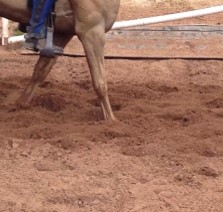
In a firm-surface scenario, the toe contacts the ground and maintains that position through stance. Breakover occurs when the heel lifts and the hoof pivots over the toe, with the moment arm between the centre of pressure and the toe being a key determinant of the tensile load in the SDFT and SL. Now take the same horse on deep sand. At landing, the toe sinks into the surface. During mid-stance, the whole foot settles. By the time the heel lifts at the initiation of breakover, the toe is deeper than it was at contact — effectively increasing the toe-lever arm relative to the surface. The horse must work harder against this extended lever. SDFT and SL strain increases accordingly.
This is mechanistically identical to the toe-grab problem in racehorse safety. Kane et al. documented the epidemiological signal. The biomechanical mechanism is the elevated toe creating an extended lever. On sand, the surface creates the elevation passively. The intervention is the same in both cases: reduce the effective toe lever. A rolled or rockered toe shoe does exactly this — it shifts the breakover point proximally relative to the ground contact, reducing the effective moment arm. This is mechanistic inference from robust foundations, and it is directly applicable in practice.
Three Questions the Evidence Raises — and Cannot Yet Answer
- Does a smooth-soled flat shoe on rubber composite genuinely reduce fetlock rotational loading compared with a creased or studded shoe? The hypothesis is mechanistically sound. The evidence does not exist. This is an eminently researchable question with current technology — force transducer studies, pressure plate analysis, kinematics — and it would settle the debate about traction on rubber arenas with data rather than opinion.
- Does a wide-webbed shoe meaningfully reduce effective hoof sinkage in fibre-modified sand, and does that translate to lower peak SDFT force? Again, mechanistically plausible. The Crevier-Denoix et al. methodology could be applied directly. A study comparing standard and wide-web shoes on two sand depths would be straightforward and clinically highly relevant.
- Is the surface transition injury risk modifiable by shoe package selection? Peel et al. (2018) documented the clinical pattern in Australian racing — the mismatch between training surface and racing surface as an injury risk factor. What shoe characteristics best buffer the biomechanical mismatch is entirely unknown. It is one of the most practically important questions in arena sport farriery.
These are not rhetorical questions. They are gaps in our evidence base that the farriery research community, working alongside equine biomechanics laboratories, is uniquely positioned to address. The methodology exists. The clinical relevance is clear. What is needed is the investment — in time, funding, and willingness to subject our practice to systematic evaluation.
Five Propositions Worth Arguing About
The following positions are deliberately provocative. They are either directly supported by published evidence, or they follow from it in ways that are defensible but not yet proven. Both sides are presented.
Debate: Proposition 1: “Studs should be the exception, not the rule, in arena work.”
▲ THE CASE FOR: Most artificial arena surfaces already provide adequate lateral stability for training work. The biomechanical cost of asymmetric stud use — altered loading axis, mediolateral pressure redistribution — is present every time studs are fitted. On rubber composite and maintained indoor synthetic, there is no published evidence that studs provide net benefit above that cost.
▼ THE CASE AGAINST: Arena surfaces vary significantly with maintenance, temperature, and moisture. A surface that needs no studs on a Tuesday morning may be slippery by Friday afternoon. The risk of a slip or stumble is acute and immediate; the biomechanical cost of appropriate stud use is cumulative and lower per exposure. Removing studs from the toolkit altogether for arena work is overcorrection from limited evidence.
Debate: Proposition 2: “A wide-web shoe should be the default for horses in sand arena work.”
▲ THE CASE FOR: The load-distribution principle from shoe design, combined with the established SDFT-sinkage relationship from Crevier-Denoix et al., provides a mechanistically coherent rationale for wide-web as the standard rather than the exception in sand environments.
▼ THE CASE AGAINST: Wide-web shoes are heavier and may alter flight arc and limb-swing kinematics. They can impair natural hoof expansion if fitted without adequate relief. “Wide web” is not a precisely defined term — the evidence does not define the threshold width. Recommending it as a default without that precision may generate more problems than it solves.
Debate: Proposition 3: “The farrier should advise on arena surface maintenance as part of their professional service.”
▲ THE CASE FOR: The shoe-surface system logic means our shoeing decisions are always partly determined by the surface. We have a professional interest in its quality and the biomechanical knowledge to advise on its maintenance. This advisory role is already present at elite level — it should be normalised at all levels of performance horse management.
▼ THE CASE AGAINST: Surface management is a specialist field with its own expertise and commercial ecosystem. Farriers who overreach into arena surface advice without specific training risk providing inaccurate guidance and undermining relationships with surface specialists. The advisory role has limits, and we should be honest about where our knowledge ends.
Debate: Proposition 4: “Shoeing intervals should be surface-specific, not calendar-based.”
▲ THE CASE FOR: A horse on abrasive plain sand wears its heels back significantly faster than a horse on rubber composite. A fixed six-week interval is appropriate for one and too long for the other. If heel height management is a critical variable in SDFT and navicular loading, then ignoring the surface’s contribution to heel wear is a clinical oversight.
▼ THE CASE AGAINST: Shortening intervals increases cost and may not always be practically achievable. Most clients do not have the flexibility for four-week intervals. And the relationship between heel wear rate and SDFT loading, though mechanistically plausible, is not directly demonstrated — we are extrapolating from biomechanical principles, not clinical outcome data.
Debate: Proposition 5: “Aluminium-composite shoes should be considered for multi-surface competition horses.”
▲ THE CASE FOR: The Vienna VGT data showing more consistent traction across surface types for aluminium-rubber composite shoes is a genuine, if preliminary, evidence signal. For horses competing across multiple surfaces, traction consistency may be a meaningful risk modifier. The evidence is emerging, not established — but so was the case for many tools we now use routinely.
▼ THE CASE AGAINST: The VGT study is small and conducted at non-competition exercise speeds. Aluminium-composite shoes are significantly more expensive, less durable on abrasive surfaces, and require different fitting technique. Recommending them on the basis of a single preliminary study is premature and may push clients toward a costly intervention before the evidence justifies it.
What This Means in Practice — Today
None of the evidence reviewed here requires us to do anything radically different tomorrow. But it does require us to ask better questions before we pick up the nippers. The questions are not complicated. They are: What surface is this horse working on? What are its mechanical properties — hard or soft, grippy or slippery, consistent or variable? What specific injury risks does that surface generate for this discipline? And is the shoe package I’m about to fit responsive to those risks?
The answers will sometimes confirm that what you were going to do anyway is correct. They will sometimes prompt a modification — a wider web, a rolled toe, a different stud, a shorter interval. Occasionally they will prompt a conversation with the owner or yard manager about the surface itself. All of these are appropriate professional responses to a body of evidence that is incomplete but not negligible.
The broader point is this: the surface is not passive. It is one of the most powerful variables in equine musculoskeletal health, and it is one that changes regularly — with the weather, with maintenance, with season, with competition schedule. A shoeing decision made in isolation from that variable is an incomplete clinical assessment. Surface literacy is not an optional extra for the performance horse farrier. It is a core clinical skill.
◆ KEY TAKEAWAYS — Summary for Practice
- Surface is a biomechanical variable, not a backdrop. It directly determines GRF loading rate, energy return, sinkage, slip, and therefore bone and soft tissue injury risk.
- The shoe works within a shoe-surface system. The same shoe will behave differently on rubber, sand, synthetic, and turf. Your shoeing decision must account for the surface.
- Rolled toes are surface-responsive farriery, not remedial farriery. Any surface that delays breakover — deep sand, cold synthetic, heavy turf — justifies a rolled toe as standard practice.
- Stud decisions need biomechanical grounding. Ask whether the surface needs additional traction before fitting studs. On rubber composite and maintained indoor synthetic, the answer is usually no.
- Heel management on sand requires interval awareness. Six-week intervals may be too long for horses in daily work on abrasive sand. Monitor heel height actively and adjust accordingly.
- Surface transitions are genuine injury risk events. Post-competition soreness and acute injury at surface transitions are not coincidental. Appropriate geometry and traction selection can reduce the biomechanical mismatch.
Key References
1. Setterbo JJ, Garcia TC, Campbell IP, et al. (2009) Hoof accelerations and ground reaction forces of Thoroughbred racehorses measured on dirt, synthetic, and turf track surfaces. American Journal of Veterinary Research, 70(10), pp. 1220–1229. doi: 10.2460/ajvr.70.10.1220
2. Crevier-Denoix N, Pourcelot P, Ravary B, et al. (2009) Influence of track surface on the in vivo loading of the superficial digital flexor tendon in two French Trotters. Equine Veterinary Journal, 41(3), pp. 257–261. doi: 10.2746/042516409X394445
3. Pardoe CH, McGuigan MP, Rogers KM, Rowe LL, Wilson AM. (2001) The effect of shoe material on the kinetics and kinematics of foot slip at landing in horses. Equine Veterinary Journal Supplement, (33), pp. 70–73. doi: 10.1111/j.2042-3306.2001.tb05363.x
4. Harvey AM, Williams SB, Singer ER. (2012) The effect of lateral heel studs on the kinematics of the equine digit while cantering on grass. The Veterinary Journal, 192(2), pp. 217–221. doi: 10.1016/j.tvjl.2011.06.003
5. Horan K, Coburn J, Kourdache K, et al. (2021) The effect of horseshoes and surfaces on horse and jockey centre of mass displacements at gallop. PLoS ONE, 16(11), e0257820. doi: 10.1371/journal.pone.0257820
6. Horan K, Coburn J, Kourdache K, et al. (2022) Hoof slip duration and shoe-surface combinations in galloping racehorses. Animals (Basel). doi: 10.3390/ani12172161
7. Bridge JW, Peterson ML, McIlwraith CW, Beaumont RM. (2010) Temperature effects on triaxial shear strength of waxed sand-synthetic surface materials. Journal of ASTM International, 7(3). doi: 10.1520/JAI102480
8. Rohlf CM, Garcia TC, Fyhrie DP, et al. (2023) Shear ground reaction forces across equine arena surfaces. The Veterinary Journal, 290, 105930. doi: 10.1016/j.tvjl.2022.105930
9. Kane AJ, Stover SM, Gardner IA, et al. (1996) Hoof size, shape, and balance as possible risk factors for catastrophic musculoskeletal injury. American Journal of Veterinary Research, 57(5), pp. 623–630.
10. Kane AJ, Stover SM, Gardner IA, et al. (1998) Horseshoe characteristics as possible risk factors for fatal musculoskeletal injury. Preventive Veterinary Medicine, 34(2–3), pp. 229–240.
11. Murray RC, Dyson SJ, Tranquille C, Adams V. (2006) Association of type of sport and performance level with anatomical site of orthopaedic injury diagnosis. Equine Veterinary Journal Supplement, 36, pp. 411–416.
12. Parkin TDH, Clegg PD, French NP, et al. (2004) Risk of fatal distal limb fractures among Thoroughbreds involved in the five types of racing in the United Kingdom. Veterinary Record, 154(16), pp. 493–497. doi: 10.1136/vr.154.16.493
13. Singer ER, Pinchbeck G, Engel M, et al. (2008) Cohort study of horse injuries occurring during three-day eventing. Equine Veterinary Journal Supplement, (36), pp. 521–524.
14. Symons JE, Hawkins DA, Fyhrie DP, et al. (2017) Modelling the effect of race surface and racehorse limb parameters on in silico fetlock motion and propensity for injury. Equine Veterinary Journal, 49(6), pp. 806–811. doi: 10.1111/evj.12672
15. Mahaffey CA, Peterson ML, Thomason JJ, McIlwraith CW. (2016) Dynamic testing of horseshoe designs at impact on two surface types. Equine Veterinary Journal, 48(2), pp. 200–205. doi: 10.1111/evj.12360
16. Peel J, Dyson SJ, Neel J, Nash M, Sinclair M. (2018) Track surfaces used for ridden workouts and alternate training modalities in Thoroughbred racehorses in Queensland, Australia. Animals (Basel), 9(1), 2. doi: 10.3390/ani9010002
17. Hobbs SJ, Clayton HM, Northrop AJ, et al. (2014) Equine Surfaces White Paper. Fédération Equestre Internationale (FEI). Available at: https://racesresearch.org
18. University of Veterinary Medicine Vienna. (2025) Comparing the difference in traction between the bare hoof, iron horseshoe, and aluminium-rubber horseshoe across surface types. Sensors, 25(19), 5975. doi: 10.3390/s25195975