Shoe fit, biomechanics, and the limits of hoof horn
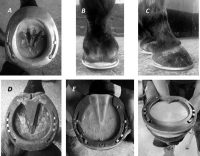
The question “Is fit a standard on every horse?” deserves a clear answer: yes. Fit is a fundamental professional standard, not a variable that changes with circumstance. However, understanding why fit matters requires moving beyond outline aesthetics and into biomechanics and material science.
Shoe fit exists to manage forces. It does not correct conformation, and it does not instantly remodel distorted feet. Its primary role is to influence how load is transferred through the hoof capsule and into the limb, while protecting the structural integrity of the horn.
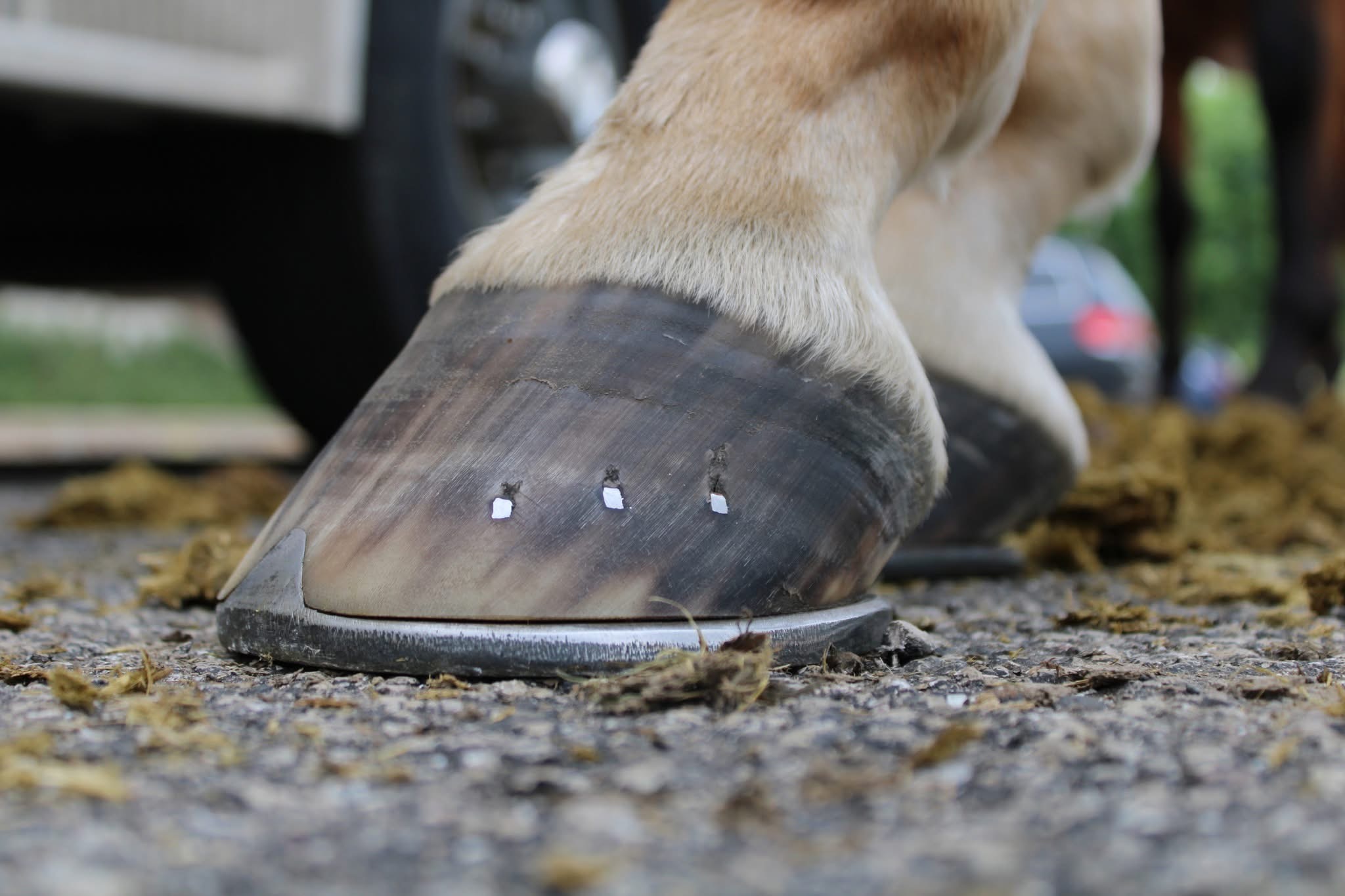
Fit 2 form, form is function, symmetrical loading is mechanical efficiency
Off-axis loading and hoof form
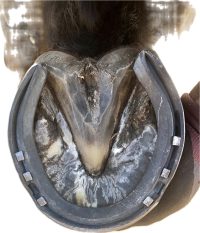
Most horses do not load their limbs symmetrically. Angular and rotational conformational deviations create off-axis loading, meaning forces are applied unevenly across the hoof capsule during stance and breakover. The hoof adapts to this loading over time, often resulting in asymmetrical wall thickness, flare, distortion, and uneven growth.
Attempting to impose a visually symmetrical shoe on an asymmetrical limb often increases, rather than reduces, stress. However, allowing the shoe to simply follow distortion without restraint also has consequences. The farrier’s role lies between these extremes: respecting limb-driven asymmetry while limiting its damaging effects.
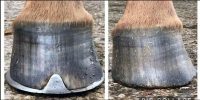
Sympathetic loading patterns help eliminate strain related morphological changes in functional hoof form, fit should not increase torque
Hoof horn as a biological elastomer
Hoof horn behaves as a viscoelastic material. Within physiological limits, it deforms elastically under load and returns to its original shape. However, horn has finite elastomeric limits. When strain exceeds these limits — due to poor load distribution, excessive lever arms, or uneven support — deformation becomes plastic.
Plastic deformation leads to:
Permanent distortion of the hoof capsule
Flare migration
Loss of wall integrity
Reduced load-sharing capacity of the capsule
Once this occurs, the hoof becomes progressively less able to manage load efficiently, and further distortion accelerates.
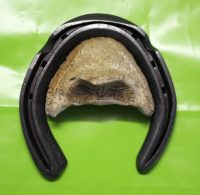
Form and Function (courtesy Craig Trinka)
Why uniformity in shoe form matters
Uniformity in shoe fit is not about visual perfection. It is about controlling strain within the horn.
A well-fitted shoe:
Distributes load evenly across the functional weight-bearing surface
Limits focal overload created by off-axis forces
Reduces excessive wall bending and shear
Helps keep horn deformation within its elastic range
By doing so, the shoe acts as a mechanical moderator, reducing the likelihood of plastic deformation and preserving structural integrity over time.
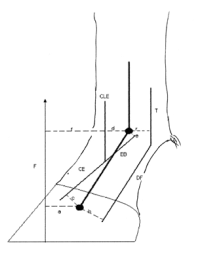
This does not mean every shoe looks identical or symmetrical. Uniformity refers to consistency of support and force management, not cosmetic symmetry.
Fit in compromised or “dire straits” cases
In pathological or compromised feet, the importance of fit increases. The goal shifts from ideal outline to mechanical protection and force redistribution. Poor fit in these cases accelerates failure because compromised horn has a reduced capacity to tolerate strain.
However, expectations must remain realistic. Fit cannot instantly reverse distortion caused by conformation, environment, or previous pathology. Progress occurs incrementally over multiple shoeing cycles.
External influences that cannot be eradicated
Several factors shape hoof form beyond the farrier’s control:
Limb conformation
Movement patterns and discipline
Environmental moisture and surface hardness
Management and shoeing intervals
Historical injury and compensatory loading
These influences can be partially mitigated, but not eliminated. Fit must therefore be adaptive and contextual rather than dogmatic.
Best practice principles for shoe fit
Based on current scientific understanding and farriery craft standards, best practice includes:
Fit to the functional, loaded foot, not the trimmed outline
Respect limb-driven asymmetry while limiting its mechanical consequences
Aim for uniform load distribution, not cosmetic symmetry
Avoid excessive lever arms that increase horn strain
Support the capsule to keep deformation within elastic limits
Assess fit dynamically, not just statically
Adjust expectations based on environment, use, and pathology
Measure progress over multiple cycles, not single visits
Communicate realistic outcomes to owners and clinicians
Accept that good fit is iterative, not instantaneous
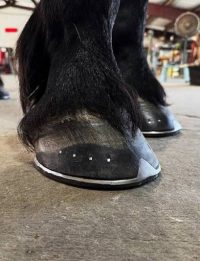
Conclusion
Fit is always the standard. But good fit is not about forcing the foot into an idealised shape. It is about managing off-axis forces, respecting the mechanical limits of hoof horn, and preserving structural integrity over time.
Uniformity in shoe form is a biomechanical necessity, not a cosmetic preference. When fit is applied consistently and intelligently, it limits plastic deformation, improves durability of the hoof capsule, and supports functional soundness — even in the presence of unavoidable conformational and environmental challenges.
That is the true purpose of fit.