

REAR WHEEL DRIVE
Mark Caldwell PhD., FWCF
In this post we explore Equine Hind Foot Form, Static Balance Proportions, and Limb Alignment: This is a brief overview.
When it comes to equine hind foot form and alignment, particularly as it relates to static balance proportions and hind limb dynamics at speed, we are dealing with a highly sophisticated biomechanical system. Understanding this system requires an integration of anatomy, physics, kinematics, and the functional demands of the horse in various gaits, particularly at speed (e.g., canter and gallop). I’ll break this down into several key sections, addressing form, alignment, balance, and dynamics in both static and dynamic contexts.
Hind Foot Form and Function Proportions:
The horse’s hoof is designed to bear weight and allow efficient locomotion. In an ideal scenario:
* The length-to-width ratio of the hind hoof should be balanced to support both the weight-bearing and propulsion functions, with the length slightly greater than the width, reflecting the natural conformation of the limb.
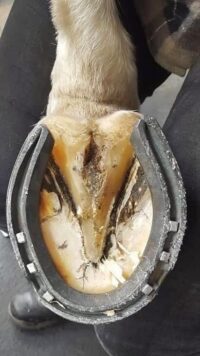
Hind foot support and the length width ratio
* The angle of the hoof wall should be approximately 50-55° to the ground, although this can vary depending on conformation, surface conditions, and use.
* The angle of the pastern should generally match the hoof angle for optimal alignment. Any misalignment can lead to stress or mechanical inefficiencies, especially at speed.
In the static phase (standing), the balance of the horse’s hind limb is crucial to prevent undue stress on the joints, ligaments, and tendons. The hind foot must be able to support the weight of the body while maintaining a neutral position to prevent fatigue or injury.
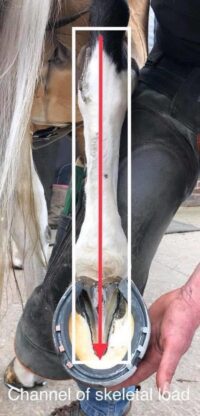
The hind foot should support the limb during the stance phase
Key Considerations in Static Balance:
* Cannon Bone Alignment: The cannon bone (metatarsus) should be aligned vertically when viewed from the side, with the hoof directly under the center of gravity. In hind limbs, any deviation from this alignment, such as toe-out or toe-in, can affect how forces are transmitted through the joints and bones.
* Breakover: The hind foot should exhibit a relatively longer breakover compared to the front limbs. This is because the hind limbs must generate more propulsive force and engage later in the stride cycle (i.e., after the forelimbs have already made ground contact and the horse is in the midst of forward propulsion). A well-balanced breakover can facilitate smoother transitions between gait phases and reduce impact forces.
* Angle of the Hoof and Pastern: The static angles of the hoof wall and the pastern should align to create a smooth, effective lever system for energy transfer. For example, if the hoof angle is too steep or too shallow, the horse may have difficulty absorbing shock or propelling itself effectively.
The dynamics of the hind limb change significantly as the horse increases speed, and alignment becomes a critical factor for efficient movement. At speed, the primary concerns shift from static load-bearing to dynamic propulsion, shock absorption, and stability.
Conformation and Alignment for Speed:
* Hind Limb Conformation: The conformation of the hind limb plays a key role in generating forward thrust. A correctly aligned hind limb ensures that the major joints (hip, stifle, hock) move in unison and allow the greatest range of motion for maximum stride length and efficiency.
* Hock angle: Ideally, the hock should align approximately 90° with the ground at the point of full extension during the stride cycle. Any misalignment here, such as a straight hock (which leads to a reduced lever arm), may hinder propulsion and cause strain during high-speed efforts.
* Stifle and Hip Flexion: As the horse moves through the gait cycle, particularly at speed, the stifle should flex and extend freely, in synchrony with the hip, which is the primary generator of forward motion.
* Hind Hoof and Weight Distribution: During fast gaits, the hind foot’s role shifts from shock absorption to propulsion. The forefoot lands first in each stride, and the hind foot follows through with a push-off. The hoof should land relatively flat, with weight distributed evenly across the hoof to ensure efficient force transfer.
* Breakover at Speed: The hind foot breakover (when the hoof leaves the ground at the end of the stride) is critical for speed. Improper breakover can cause the hind foot to linger too long on the ground, thus impeding efficient forward motion.
* Hind Foot Dynamics: At higher speeds, especially during the canter or gallop, the hind foot must leave the ground quickly and the toe should be able to disengage easily (without dragging), ensuring that forward motion is as explosive as possible.
Muscle and Tendon Involvement:
* Power Generation: The primary power for propulsion comes from the gluteal muscles and hamstrings, which generate the force required to extend the hind limb during each stride. This force is transferred through the hock to the hoof.
* Elastic Recoil: The digital cushion, frog, and pastern ligaments provide significant shock absorption during the landing phase, while the flexor tendons (deep digital flexor tendon and superficial digital flexor tendon) act as elastic recoil mechanisms during the push-off
At high speeds, the forces acting on the hind limb change, and kinematic efficiency becomes even more important:
* Kinematics and Limb Length: A horse with longer hind limbs (relative to body size) can take longer strides and move more quickly. However, these limbs also need to be well-aligned for efficient energy transfer. Misalignment can lead to unnecessary energy loss, increasing the risk of injury and decreasing overall speed.
* Torque and Lever Mechanics: The hind limb functions as a lever system with the hip as the fulcrum, the hock as the distal lever, and the hoof providing the point of ground contact. A straight-line force vector (as seen in optimal limb alignment) allows efficient energy transfer from the muscles to the ground, resulting in powerful, effective propulsion.
* The Role of the Hind Foot in Propulsion: The hind foot must push off the ground powerfully but with control. During high-speed gaits, the toe of the hind foot is often the first point to leave the ground, and the rear limb should extend rapidly, creating maximum stride length and driving the body forward.

The understanding of hind foot form, static balance, and alignment is crucial for equine performance—particularly in sports that require speed (e.g., racing, eventing, jumping). Proper dynamic alignment of the hind limb ensures that the horse can generate maximum force while maintaining stability and minimizing the risk of injury. In high-speed movements:
* Biomechanical Efficiency: Proper alignment and balance contribute to the efficient use of energy during movement, reducing fatigue and increasing speed over longer distances.
* Shock Absorption: The correct hoof form and alignment help to dissipate the forces generated during landing, particularly at high speeds, which minimizes the risk of damage to joints, ligaments, and tendons.
* Propulsion: Alignment and form also determine how effectively the hind foot generates thrust during the push-off phase, a critical component in maintaining speed and performance.
In conclusion, the interaction between static balance, limb alignment, and dynamic performance at speed is foundational for the horse’s ability to perform at its best. Proper form and alignment optimize the horse’s natural biomechanics, enabling it to move efficiently, reduce the risk of injury, and perform at high levels of speed and agility.
#hoofflix #scientifichorseshoeing #hoofcare #farrier #horses #equine #equinebiomechanics #equinetherapy #horseshoeing