
Mediolateral Balance of the Equine Foot: A Critical Re-evaluation of Definition and Assessment within a Practical and Mechanistic Clinical Framework
A Structured Evidence Review for the Equine Farriery and Veterinary Professions
M. Caldwell*. FWCF; PhD.
*Scientific Horseshoeing, 116, Necastle Road, Talke, Staffordshire. ST7 1SA, UK
*Corresponding author:mark@scientifichorseshoeing.co.uk
Keywords: equine, ML balance, farriery, biomechanics, assessment, trimming.
Preamble: Why the Existing Definition Requires Revision
The conventional definition of mediolateral (ML) balance — framing it as “equality of loading on the medial and lateral aspects of the foot” assessed by whether the coronary band runs at equal heights on both sides, or whether the ground surface tilts no more than 3° from horizontal — has provided useful clinical shorthand for over a century. However, convergent evidence from biomechanical instrumentation studies, pressure plate research, radiographic investigation, FEA modelling, and graduate-level research conducted between 1995 and 2024 reveals this definition to be both mechanistically incomplete and clinically misleading in several important respects.
The primary deficiencies are:
- Static geometry does not predict dynamic loading. Multiple pressure plate studies demonstrate that a visually level hoof can generate significantly asymmetric ground reaction forces (GRFs) throughout stance, and conversely that a laterally landing hoof may achieve a well-centred centre of pressure (CoP) at midstance — the biomechanically critical moment.
- Landing pattern is not synonymous with midstance load distribution. Clinical and teaching tradition in farriery has focused on achieving a level hoof landing. However, the forces at initial impact are an order of magnitude smaller than those at midstance, and a flat landing does not guarantee centralised CoP loading during the high-force phase of the stance.
- The 3° threshold lacks validated derivation. No controlled clinical or biomechanical trial has established 3° as a threshold for pathological imbalance; this figure appears to derive from consensus convention rather than evidence.
- The distal phalanx (P3) and DIPJ — not the solar surface — define true internal balance. Radiographic and FEA evidence confirms that hoof capsule asymmetry may or may not reflect internal phalangeal and joint-space asymmetry, and that clinical assessment without radiography cannot reliably determine the internal balance state.
- Mediolateral balance is profoundly individual and conformation-dependent. What constitutes “ideal” mediolateral balance cannot be reduced to a universal geometric standard because it is modulated by proximal limb conformation, breed, posture, gait, and workload — factors that vary substantially between individuals.
- Morphological change is driven by cumulative impulse, not landing. Hoof wall distortion, flaring, and asymmetric growth are the products of sustained asymmetric pressure over time (impulse = force × time), not the brief transient forces of initial ground contact.
The following revised definition and assessment framework attempts to integrate all of these dimensions.
PART I: REVISED DEFINITION
1.1 Proposed Comprehensive Definition
Mediolateral balance of the equine foot is a three-dimensional, dynamically variable, and individually specific functional state in which the distribution of ground reaction forces (GRFs) and their cumulative impulses across the medial and lateral aspects of the solar bearing surface supports optimal loading of the distal interphalangeal joint (DIPJ), associated articular cartilage, collateral ligaments, ungular cartilages, hoof wall lamellae, and digital vasculature — in a manner appropriate to the individual horse’s proximal limb conformation, gait, workload, and foot type.
In the ideally balanced foot:
- The centre of pressure (CoP) at midstance approximates the centre of rotation (CoR) of the DIPJ, as determined by the external reference point (eCoR) at the widest point of the foot (Caldwell et al., 2016);
- The cumulative mediolateral impulse throughout the stance phase is appropriately distributed relative to the individual’s conformation, with neither the medial nor lateral aspect consistently bearing disproportionate loads that exceed the viscoelastic tolerance of hoof horn and internal soft tissues;
- The distal phalanx is oriented within the hoof capsule such that the solar margin is level or within a clinically acceptable range (positive or neutral plantar/palmar angle) on dorsopalmar (DP) radiographic projection, and the joint space of the DIPJ is symmetrical mediolaterally;
- The hoof capsule morphology — including medial and lateral wall lengths, coronary band heights, and solar symmetry — reflects the loading history of the limb and approximates, but need not perfectly replicate, geometric symmetry;
- The landing pattern (medial-first, lateral-first, or flat) is considered within the context of proximal limb conformation and gait, acknowledging that lateral-first or flat landing is physiologically normal in the majority of sound horses.
1.2 Critical Distinctions
Static vs. Dynamic Balance
Static (geometric) balance refers to the morphometric relationships visible when the horse stands at rest on a level surface: coronary band symmetry, medial-to-lateral wall length, wall angles, and capsule symmetry. It is a surrogate indicator of loading history and a starting point for clinical assessment, not an independent measure of functional adequacy.
Dynamic (functional) balance refers to the distribution of GRFs, CoP trajectory, and cumulative impulse throughout the stance phase in motion. This dimension — measurable via pressure plate, force plate, and instrumented shoes — reflects the actual mechanical environment experienced by the internal structures of the foot.
The two are related but not synonymous. A morphometrically symmetrical foot may generate asymmetric dynamic loading if proximal limb conformation or muscular dynamics bias the GRF vector medially or laterally. Equally, a horse with inherent mediolateral capsule asymmetry suited to its conformation may maintain centralised CoP loading throughout stance.
Capsule Balance vs. Internal (Skeletal) Balance
Capsule balance describes the external morphometric state of the hoof. Internal (skeletal) balance describes the spatial relationship of P3 and the DIPJ within the capsule and their orientation relative to the ground. The two may diverge substantially: adaptive hoof growth, asymmetric wear, or trimming error can produce a morphometrically asymmetric capsule while the internal skeletal structures remain appropriately oriented, and vice versa.
Individual vs. Universal Balance
Evidence demonstrates that there is no single universal standard for mediolateral balance applicable to all horses. The appropriate mediolateral distribution of load is modulated by: breed and body mass; proximal limb conformation (varus/valgus angulation, carpal and tarsal alignment); stance width; foot type; shoeing interval; workload surface; and gait. What appears visually “unbalanced” in one individual may represent a functional adaptation appropriate to that horse’s conformation.
PART II: MECHANISTIC FRAMEWORK
2.1 Forces in the Mediolateral Plane
The equine distal limb is subjected to three primary force types in the mediolateral plane:
- Vertical GRF vector — whose mediolateral position relative to the foot determines the bending moment imposed on the DIPJ in the frontal plane;
- Torsional (rotational) forces — generated during landing, unrollment, and breakover, particularly when the foot does not land flat;
- Capsular creep forces — sustained, time-dependent deformation of hoof horn under asymmetric loading, which ultimately produces morphological asymmetry (flaring, wall distortion, coronary band displacement).
The CoP — the calculated ground-plane point of application of the GRF — integrates all of these forces. Its mediolateral position throughout stance determines which structures bear disproportionate load.
2.2 Biomechanical Consequences of Mediolateral Imbalance
A persistently medially or laterally displaced CoP:
- Increases the bending moment on the DIPJ in the frontal plane, predisposing to asymmetric articular cartilage loading, collateral ligament strain, and ultimately degenerative joint disease;
- Concentrates compressive and shear stress in the laminar junction on the overloaded side, risking lamellar failure and wall distortion;
- Creates asymmetric loading of the ungular cartilages, predisposing to asymmetric ossification (sidebone) and associated collateral ligament pathology;
- Generates asymmetric haemodynamic function within the palmar/plantar plexus, potentially impairing circulation and hoof horn quality;
- Transmits asymmetric forces proximally through the pastern and fetlock, with potential for suspensory ligament asymmetry, fetlock joint pathology, and distal limb rotation.
FEA modelling confirms that asymmetric mediolateral loading produces elevated Von Mises stress concentrations in the proximal dorsal wall, lateral hoof wall, and distal heel regions — areas commonly associated with clinical wall distortion and keratoma formation.
2.3 Landing Pattern vs. Midstance Loading
Pressure plate studies consistently demonstrate that the mediolateral position of the CoP at initial ground contact does not predict its position at midstance. In sound horses:
- Lateral-first or flat landing is the most common pattern at trot;
- The CoP migrates medially toward the centre during the loading phase;
- Midstance CoP position — not initial landing — determines the primary biomechanical loading of internal structures;
- Impulse (force × time) during midstance substantially exceeds that at initial contact.
This dissociation between landing pattern and midstance loading has fundamental implications for farriery practice: interventions aimed solely at achieving a visually flat landing may not optimise — and could potentially compromise — midstance loading patterns.
PART III: REVISED CLINICAL ASSESSMENT FRAMEWORK
Assessment of mediolateral balance requires a structured, multi-step approach that integrates static, dynamic, radiographic, and functional observations. No single measurement or observation is adequate in isolation.
3.1 Step 1 — Preparatory Observation: Posture and Proximal Limb Conformation
Before examining the foot, the horse is observed standing square on a firm, level surface from the front, side, and rear. The following are documented:
- Stance width (base-wide, base-narrow, or normal);
- Rotational alignment of the distal limb (toed-in, toed-out, or straight);
- Varus or valgus angulation at the carpus and fetlock;
- Postural symmetry including body carriage, muscle mass symmetry, and any compensatory weight shifting;
- Hoof placement pattern: whether both feet are placed symmetrically and whether the horse actively loads one aspect more than another.
This step is essential because proximal limb conformation and stance pattern are primary determinants of mediolateral CoP position and cannot be corrected by farriery to the ground-bearing surface alone.
3.2 Step 2 — Static Morphometric Assessment
With the horse standing square, the following observations are made from the front and rear:
From the front:
- Coronary band height symmetry: Using a visual or physical reference (straight-edge or digital photograph from ground level), assess whether the medial and lateral coronary band heights are level. Asymmetry is the most readily observable static indicator of mediolateral imbalance, but reflects loading history rather than current mechanical state.
- Wall angle symmetry: The medial and lateral walls should diverge at approximately equal angles from vertical. Marked flare or contraction on one side indicates asymmetric loading.
- Solar symmetry: Viewed from the solar surface, medial and lateral halves of the foot should be approximately equal in area about the sagittal axis of the frog. Significant asymmetry of the white line, toe shape, or heel buttress position indicates loading asymmetry.
- Coronary band distortion: Notching, displacement, or flattening of the coronary band on one side indicates concentrated loading of the underlying wall segment.
From the rear:
- The centre of the pastern and metacarpus (or metatarsus) should, in the ideal limb, bisect the foot symmetrically. Deviation of the phalangeal column medially or laterally above the foot provides critical context for any capsule asymmetry observed.
Bubble level / T-square assessment (Traditional Method):
With the horse standing on a flat, level surface, a T-square or spirit level is applied across the bearing surface of the foot or shoe. This indicates whether the ground surface is tilted mediolaterally. While practical, this method:
- Assesses only the angle of the bearing surface of the capsule, not the internal phalangeal or DIPJ alignment;
- Is significantly affected by surface levelness, stance variation, and horse posture;
- Cannot reveal whether any observed tilt reflects problematic internal imbalance or appropriate adaptation to conformation;
- Should be recorded with the horse standing squarely, bipedal, on a verified level surface.
A bearing surface tilt of more than 3–5° from horizontal warrants further investigation but is not independently diagnostic of pathological imbalance without contextual assessment. This threshold should be used as an indicator for further assessment rather than as a definitive criterion.
3.3 Step 3 — Dynamic Assessment: Observation in Motion
The horse is observed walking, trotting, and (where appropriate) cantering on a firm, level surface. The following are documented:
- Landing pattern: Whether the foot lands medially, laterally, or flat at initial ground contact. Recorded from behind at walk and trot using slow-motion video. Lateral-first landing is physiologically normal in the majority of sound horses; marked medial-first landing is associated with pathology of the lateral structures of the foot and may indicate lateral CoP displacement.
- Unrollment pattern: How the foot progresses from initial contact through midstance to breakover. An abrupt lateral or medial skew during loading suggests mediolateral asymmetry in the loading phase.
- Breakover point: Whether breakover occurs symmetrically at the toe or deviates medially or laterally.
- Limb flight and foot placement: Whether the foot is placed consistently under the centre of mass or habitually to one side.
Important limitation: Landing observation — even with slow-motion video — reflects only the brief high-frequency impact phase of the stance. It does not permit evaluation of midstance CoP position or cumulative impulse distribution. Dynamic assessment should therefore inform, but not solely determine, farriery interventions.
Instrumented dynamic assessment (reference standard):
Where available, pressure plate or force plate analysis provides objective, quantitative data on CoP trajectory and mediolateral load distribution throughout the entire stance phase. This represents the current reference standard for dynamic mediolateral balance assessment and should be used in research, performance horses, and complex clinical cases. It is not currently standard in field farriery practice.
3.4 Step 4 — Radiographic Assessment (Gold Standard for Internal Balance)
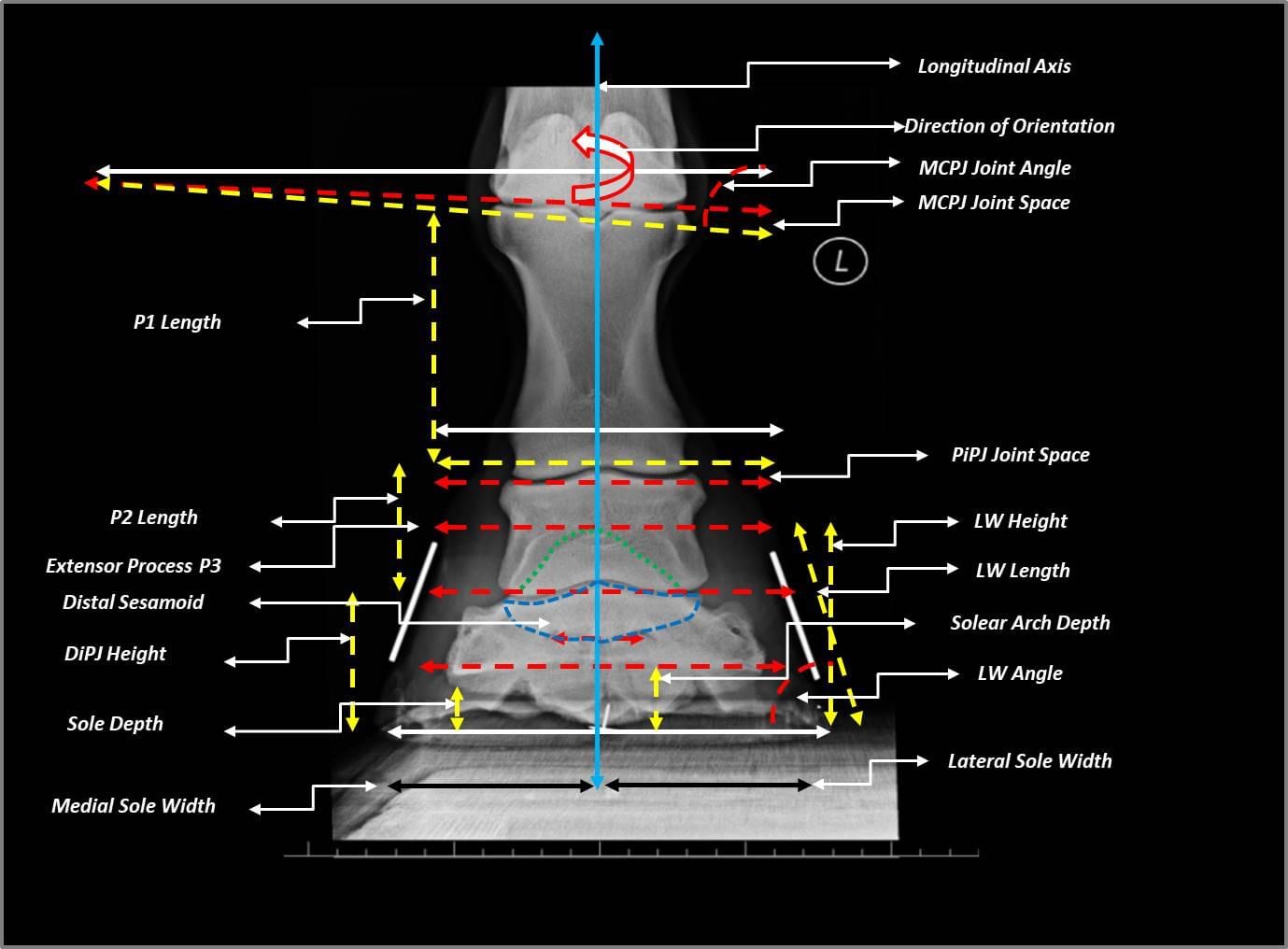
Dorsopalmar (DP) and dorsoplantar (DPl) radiographic projections provide the only reliable method of assessing internal mediolateral balance: the orientation of P3 within the capsule and the symmetry of the DIPJ space. Radiographic assessment should be considered in:
- Horses with persistent mediolateral capsule asymmetry;
- Cases with associated lameness localised to the foot;
- Horses with a history of collateral ligament injury, sidebone, or keratoma;
- Pre-purchase examination where mediolateral asymmetry is evident;
- Therapeutic farriery planning for corrective shoeing.
Radiographic protocol (standardised):
The horse must be standing bipedally, with both forelimbs or both hindlimbs placed symmetrically on a level platform, bearing equal weight. The metacarpus (or metatarsus) must be perpendicular to the ground in both the sagittal and frontal planes. The X-ray beam must be directed in the true dorsopalmar plane. Research demonstrates that even 5° of limb abduction produces a statistically significant change (approximately 1.2 mm) in measured DIPJ mediolateral space width, and 10° abduction produces approximately 2.5 mm change — sufficient to falsely diagnose or mask clinically relevant imbalance.
Parameters measured on DP projection:
- Medial and lateral DIPJ joint space widths (measured at standardised points approximately 1/6 of joint width from each margin);
- Medial and lateral hoof wall lengths;
- Medial and lateral solar margin heights of P3;
- Medial and lateral ungular cartilage symmetry;
- Position of the phalangeal axis relative to the midline of P3.
Interpretation:
True internal mediolateral imbalance is characterised by asymmetric DIPJ joint space (wider on the unloaded side), asymmetric P3 solar margin heights, and/or mediolateral deviation of the phalangeal column above the foot. These findings indicate that the distal phalanx is tilted within the capsule under asymmetric loading, and direct trimming/shoeing decisions accordingly. Capsule asymmetry without corresponding internal asymmetry may indicate adaptive hoof growth appropriate to conformation and does not necessarily warrant aggressive correction.
3.5 Step 5 — Hoof Mapping and External Reference Point Assessment
The hoof mapping protocol developed by Caldwell et al. (2016) — based on the earlier work of Duckett (1990) — provides a systematic method for identifying the external reference points corresponding to internal DIPJ anatomy:
- The external centre of rotation (eCoR), located at the intersection of diagonal lines projected from the heel buttresses and parallel lines at the white line, corresponds to the internal CoR of the DIPJ and Duckett’s bridge;
- The dorsal breakover point corresponds to the dorsodistal tip of P3.
Assessment of mediolateral symmetry using this mapping system — whether by direct measurement, digital photography, or photogrammetric software — allows evaluation of whether medial and lateral aspects of the foot are proportionally balanced around the eCoR in both sagittal and frontal planes. This provides a more biomechanically grounded assessment than simple coronary band height comparison.
3.6 Step 6 — Synthesis and Clinical Classification
Following the above assessment, the clinician should classify the mediolateral balance state as follows:
| Classification | Characteristics |
| Type 1 — Appropriate Functional Balance | Capsule may show mild asymmetry; landing lateral or flat; CoP central at midstance; no internal imbalance radiographically; no associated pathology. Management: routine farriery interval. |
| Type 2 — Adaptive Capsule Asymmetry | Capsule asymmetry present; consistent with proximal limb conformation (e.g. varus); internal balance within normal limits on DP projection; no lameness. Management: monitor, address proximal conformation influences where possible, avoid forced correction to geometric symmetry. |
| Type 3 — Functionally Significant Imbalance | Capsule asymmetry; medial-first landing; abnormal CoP trajectory; internal asymmetry on DP projection (asymmetric DIPJ space, P3 tilt); may or may not have associated lameness. Management: corrective trimming and/or shoeing directed at restoring internal balance. |
| Type 4 — Pathological Imbalance with Secondary Change | All of the above plus: collateral ligament desmopathy, sidebone, DIP joint OA, keratoma, or chronic wall distortion. Management: collaborative veterinary and farriery approach; radiographic monitoring essential. |
PART IV: PRINCIPLES FOR CORRECTIVE INTERVENTION
4.1 Primary Principles
- Correct to the individual, not to a universal geometric standard. The goal is optimal loading for the individual horse’s conformation, not symmetric capsule morphometry.
- Prioritise internal balance over external appearance. DP radiographic assessment should guide significant corrective trimming.
- Address proximal causes where possible. Mediolateral imbalance secondary to proximal limb conformational defects cannot be fully corrected at the foot; over-correction risks shifting load asymmetrically and creating secondary pathology.
- Use incremental, monitored correction. Rapid correction of established mediolateral imbalance can displace CoP toward the opposite side and create new loading asymmetry. Gradual correction over multiple shoeing intervals is preferred.
- Do not force level landing at the expense of midstance loading. Trimming or shoeing specifically to achieve a level hoof landing when proximal conformation dictates lateral landing may create asymmetric CoP distribution during the high-force midstance phase.
4.2 Trimming
- Remove horn from the overloaded (longer/flared) side incrementally, within the limits of sole depth and horn thickness as assessed by palpation and, ideally, radiography;
- Maintain the eCoR as the reference point for mediolateral balance around the foot’s widest point;
- Ensure heel buttresses are level and at equal height relative to the solar plane;
- Reassess standing balance and dynamic pattern at every shoeing cycle.
4.3 Shoeing and Prosthetics
- Wide-web or full-support shoes increase the solar bearing surface on the deficient side;
- Side extensions or lateral/medial branches can selectively increase the support base in the direction of the imbalance;
- Mediolateral wedge pads elevate one side of the bearing surface and shift CoP toward the elevated side — noting that this shifts load rather than correcting the underlying cause;
FEA evidence confirms that nail placement and clip position alter stress distribution in the hoof wall; these factors should be considered in complex cases.
Summary: Key Departures from the Original Definition
| Original Definition Element | Evidence-Based Revision |
| “Equality of loading on medial and lateral aspects” | Absolute equality of loading is neither physiologically normal nor consistently achievable; optimal loading is individually appropriate distribution centred on the DIPJ CoR |
| Coronary band at equal heights = balanced | Coronary band height is a static surrogate for loading history, not a measure of current or dynamic balance |
| Most reliable indicator = mediolateral hoof wall angle | Most reliable indicator for internal balance = DP radiographic assessment; most reliable dynamic indicator = pressure plate CoP analysis |
| Clinical measurement with bubble level = practical approximation | Bubble level measures bearing surface tilt only; it does not assess internal phalangeal orientation, DIPJ symmetry, or dynamic CoP position |
| Tilt >3° from horizontal = clinically imbalanced | The 3° threshold lacks validated derivation; it should be used only as a trigger for further investigation, not as an independent diagnostic criterion |
| No discussion of proximal limb conformation | Proximal limb conformation is a primary determinant of mediolateral loading and must be assessed before interpreting foot balance findings |
| No distinction between static and dynamic balance | The two dimensions are distinct and may not correlate; clinical assessment must address both |
| No mention of landing vs. midstance distinction | Landing pattern reflects only the low-force initial contact phase; midstance CoP position during maximum loading is the biomechanically critical variable |
PART V: ANNOTATED REFERENCE LIST WITH EVIDENCE GRADES
Evidence grade tags are adapted from the Oxford Centre for Evidence-Based Medicine (OCEBM) Levels of Evidence framework:
- Grade A = Systematic review or high-quality RCT / multiple concordant Level 2 studies
- Grade B = Prospective controlled study, cohort study, or well-designed experimental study
- Grade C = Retrospective study, case series, observational study, or modelling study
- Grade D = Expert opinion, consensus, textbook, thesis, or review
Biomechanics and Dynamic Loading
van Heel, M.C.V., Barneveld, A., van Weeren, P.R. and Back, W. (2004) ‘Dynamic pressure measurements for the detailed study of hoof balance: the effect of trimming’, Equine Veterinary Journal, 36(8), pp. 778–782. DOI: 10.2746/0425164044847993.
Relevance: Landmark study establishing that sound horses preferentially land laterally or asymmetrically; that trimming decreases intra-individual left/right CoP difference; and that CoP travels toward maximum lateral deviation before returning toward the dorsopalmar axis during unrollment. Establishes the CoP trace as a key tool for evaluating ML balance. Grade B
van Heel, M.C.V., van Weeren, P.R. and Back, W. (2005) ‘Changes in location of centre of pressure and hoof-unrollment pattern in relation to an 8-week shoeing interval in the horse’, Equine Veterinary Journal, 37(6), pp. 536–540. DOI: 10.2746/042516405775314925.
Relevance: Demonstrates that hoof growth over an 8-week shoeing interval produces a palmar shift of CoP, increased landing time, and altered unrollment — with implications for how “balance” changes between farriery cycles. Challenges simplistic static definitions of ML balance. Grade B
Wilson, A.M., Seelig, T.J., Shield, R.A. and Silverman, B.W. (1998) ‘The effect of foot imbalance on point of force application in the horse’, Equine Veterinary Journal, 30(6), pp. 540–545. DOI: 10.1111/j.2042-3306.1998.tb04531.x.
Relevance: Demonstrates that experimentally induced mediolateral wedging displaces the point of force application approximately 10 mm in the direction of elevation throughout stance, and that the horse cannot redistribute load to compensate for acute imbalance. Provides key evidence linking ML imbalance to altered GRF. Grade B
Oosterlinck, M., Hardeman, L.C., van der Meij, B.R., Veraa, S., van der Kolk, J.H., Wijnberg, I.D., Pille, F. and Back, W. (2013) ‘Pressure plate analysis of toe-heel and medio-lateral hoof balance at the walk and trot in sound sport horses’, The Veterinary Journal, 198(Suppl 1), pp. e9–e13. DOI: 10.1016/j.tvjl.2013.09.026.
Relevance: First study to use pressure plate analysis to quantify dynamic ML balance throughout the complete stance phase. Finds gait-dependent differences in mediolateral GRF distribution; lateral loading predominates at walk, with asymmetry at trot. Demonstrates that sound horses do not display simple mediolateral GRF symmetry. Grade B
Oosterlinck, M., Van der Aa, R., Van de Water, E. and Pille, F. (2015) ‘Preliminary evaluation of toe-heel and mediolateral hoof balance at the walk in sound horses with toed-in hoof conformation’, Journal of Equine Veterinary Science, 35(7), pp. 606–610. DOI: 10.1016/j.jevs.2015.06.012.
Relevance: Demonstrates that asymmetric medial-lateral wall heights are associated with DIPJ pathology due to abnormal loading. Shows that mediolateral hoof balance curves in toed-in horses are similar to normal horses, questioning whether correction of conformation-associated asymmetry is warranted. Grade C
Mokry, A., Van de Water, E., Politiek, H.T., van Doorn, D.A., Pille, F. and Oosterlinck, M. (2021) ‘Dynamic evaluation of toe-heel and medio-lateral load distribution and hoof landing patterns in sound, unshod Standardbred horses with toed-in, toed-out and normal hoof conformation’, The Veterinary Journal, 268, p. 105593. DOI: 10.1016/j.tvjl.2020.105593.
Relevance: Most recent large-scale pressure plate study examining landing patterns and load distribution in horses with varying hoof conformations. Finds flat landing slightly more frequent overall; lateral loading patterns persist at midstance regardless of initial landing. Reinforces the need to consider midstance loading rather than landing alone. Grade B
Moleman, M., van Heel, M.C., van Weeren, P.R. and Back, W. (2006) ‘Hoof growth between two shoeing sessions leads to a substantial increase of the moment about the distal, but not the proximal, interphalangeal joint’, Equine Veterinary Journal, 38(2), pp. 170–174. DOI: 10.2746/042516406776563242.
Relevance: Demonstrates that hoof growth, by increasing toe length, substantially increases the flexor moment at the DIPJ — with direct implications for both dorsopalmar and mediolateral balance during the shoeing cycle. Grade B
Radiographic Assessment
Pauwels, F.E., Dyson, S.J., Murray, R.C. and Tranquille, C.A. (2017) ‘Radiographic measurements of hoof balance are significantly influenced by a horse’s stance’, Veterinary Radiology and Ultrasound, 58(1), pp. 10–18. DOI: 10.1111/vru.12443.
Relevance: Demonstrates that the horse’s craniocaudal and lateromedial stance during radiography significantly alters hoof balance measurements. Hoof-pastern angle shows a linear relationship (R² = 0.89) with craniocaudal stance. Critically important for standardising radiographic protocol in ML balance assessment. Grade B
Contino, E.K., Morley, P.S., Bhaskara, A. and McIlwraith, C.W. (2014) ‘Effect of limb positioning on the radiographic appearance of the distal and proximal interphalangeal joint spaces of the forelimbs of horses during evaluation of dorsopalmar radiographs’, Journal of the American Veterinary Medical Association, 244(10), pp. 1186–1191. DOI: 10.2460/javma.244.10.1186.
Relevance: Quantifies the effect of limb abduction on DIPJ space measurement: 5° abduction increases measured mediolateral joint balance by 1.2 mm; 10° abduction by 2.5 mm. Essential reference for radiographic standardisation in ML balance assessment. Grade B
Dyson, S.J., Tranquille, C.A., Collins, S.N., Parkin, T.D.H. and Murray, R.C. (2011) ‘An investigation of the relationships between angles and shapes of the hoof capsule and the distal phalanx’, Equine Veterinary Journal, 43(3), pp. 295–301. DOI: 10.1111/j.2042-3306.2010.00162.x.
Relevance: Documents the relationship between hoof capsule external morphometry and P3 angles; demonstrates that heel-to-toe height ratio above 3:1 is associated with increased lameness risk; establishes that external appearance does not consistently predict internal P3 orientation. Grade B
Kummer, M., Geyer, H., Imboden, I., Auer, J. and Lischer, C. (2006) ‘The effect of hoof trimming on radiographic measurements of the position of the pedal bone in the horse’, The Veterinary Journal, 172(3), pp. 522–530. DOI: 10.1016/j.tvjl.2005.06.009.
Relevance: Demonstrates significant inter-farrier variation in radiographic hoof balance parameters following standardised trimming protocols. Fourteen of fifteen measured parameters showed significant differences between six farriers — indicating the importance of standardised protocols and objective measurement. Grade B
FEA Modelling
Hinterhofer, C., Stanek, C. and Haider, H. (2001) ‘Finite element analysis (FEA) as a model to predict effects of farriery on the equine hoof’, Equine Veterinary Journal, 33(Suppl 33), pp. 58–62. DOI: 10.1111/j.2042-3306.2001.tb05360.x.
Relevance: Pioneering FEA study mapping stress distribution in the hoof capsule under different shoeing conditions. Identifies high-stress zones in the proximal dorsal wall, distal heel, and lateral hoof wall. Demonstrates that nail placement and clip position significantly alter capsular stress distribution — relevant to mediolateral farriery interventions. Grade C (modelling study)
Thomason, J.J., McClinchey, H.L. and Jofriet, J.C. (2002) ‘Analysis of strain and stress in the equine hoof capsule using finite element methods: comparison with principal strains recorded in vivo’, Equine Veterinary Journal, 34(7), pp. 719–725. DOI: 10.2746/042516402776250388.
Relevance: Validates FEA as a methodology for predicting hoof capsule strain distributions by comparing model outputs with in vivo strain gauge data. Provides the biomechanical basis for understanding how asymmetric loading produces differential capsular strain and subsequent morphological adaptation. Grade C (modelling + experimental validation)
Thomason, J.J., McClinchey, H.L., Faramarzi, B. and Jofriet, J.C. (2005) ‘Mechanical behaviour and quantitative morphology of the equine laminar junction’, Anatomical Record Part A, 283A(2), pp. 366–379. DOI: 10.1002/ar.a.20173.
Relevance: FEA study examining circumferential and proximodistal stress distribution in the laminar junction. Demonstrates that asymmetric mediolateral loading produces differential laminar stress and may drive the remodelling of primary epidermal laminae observed in chronically imbalanced feet. Grade C (modelling study)
McClinchey, H.L., Thomason, J.J. and Jofriet, J.C. (2003) ‘Isolating the effects of equine hoof shape measurements on capsule strain with finite element analysis’, Veterinary and Comparative Orthopaedics and Traumatology, 16(2), pp. 67–75. DOI: 10.1055/s-0038-1632742.
Relevance: FEA analysis isolating the effects of toe angle, toe length, and wall thickness on hoof capsule strain. Demonstrates that hoof shape directly determines internal stress distribution — supporting the mechanistic basis for shape-based (morphometric) assessment of ML balance. Grade C (modelling study)
Thesis Research and Systematic Reviews
Caldwell, M.N. (2017) An investigation into the use of hoof balance metrics to test the reliability of a commonly used foot trimming protocol and their association with biomechanics and pathologies of the equine digit. PhD thesis, University of Liverpool. Available at: https://livrepository.liverpool.ac.uk/3012434/
Relevance: Landmark doctoral thesis (FWCF) demonstrating that widely accepted measures of geometric hoof balance (equivalence of proportions around the eCoR/COP) are rarely achieved following standard trimming protocols in cadaver and live horse populations. Links hoof measurement proportions to specific digital pathologies including navicular disease and DIPJ degenerative joint disease via MRI-confirmed findings. Proposes a hoof mapping protocol for locating the eCoR. Establishes that solar arch form correlates with pathological risk. Grade B (doctoral research, multi-study)
Caldwell, M.N., Allan, L.A., Pinchbeck, G.L., Clegg, P.D., Kissick, K.E. and Milner, P.I. (2016) ‘A test of the universal applicability of a commonly used principle of hoof balance’, The Veterinary Journal, 207, pp. 169–176. DOI: 10.1016/j.tvjl.2015.10.003.
Relevance: Peer-reviewed publication derived from Caldwell’s PhD research. Demonstrates that equivalence of geometric proportions as a measure of static hoof balance is not commonly present following standard trimming. Shows that eCoR reliably corresponds to internal CoR of the DIPJ radiographically. Challenges universal application of geometric balance models. Grade B
Hagen, J., Geburek, F., Kathrinaki, V., Naem, M.A., Roecken, M. and Hoffmann, J. (2017) ‘Immediate, short and long-term effects of hoof trimming on hoof-ground contact in the horse at the walk’, Australian Equine Veterinarian, 36(1).
Relevance: Demonstrates that trimming effects on hoof landing are minimal at the scale detectable beyond visual observation; suggests that landing patterns are more influenced by proximal limb joint angles and central pattern generators than by hoof morphology alone. Directly challenges the clinical practice of trimming primarily to achieve flat landings. Grade B
Conformation and Proximal Influences
Wilson, A., Agass, R., Vaux, S., Sherlock, E., Day, P., Pfau, T. and Weller, R. (2016) ‘Foot placement of the equine forelimb: relationship between foot conformation, foot placement and movement asymmetry’, Equine Veterinary Journal, 48(1), pp. 90–96. DOI: 10.1111/evj.12378.
Relevance: Demonstrates that foot placement during locomotion is related to foot conformation and movement asymmetry, reinforcing that mediolateral balance must be assessed as part of the whole-limb, dynamic system rather than at the foot in isolation. Grade B
Caudron, I., Grulke, S., Farnir, F., Aupaix, R. and Serteyn, D. (1998) ‘Radiographic assessment of equine interphalangeal joints asymmetry: articular impact of asymmetrical bearings (part II)’, Journal of Veterinary Medicine Series A, 45(1–10), pp. 297–304. DOI: 10.1111/j.1439-0442.1998.tb00831.x.
Relevance: Experimental evidence that asymmetric bearing (lateral wedging) causes phalangeal rotation, joint space asymmetry, and articular impact throughout the distal limb — providing mechanistic support for the pathological consequences of mediolateral imbalance. Grade B
Dyson, S. and Murray, R. (2010) ‘Is there an association between ossification of the cartilages of the foot and collateral desmopathy of the distal interphalangeal joint or distal phalanx injury?’, Equine Veterinary Journal, 42(6), pp. 504–511. DOI: 10.1111/j.2042-3306.2010.00100.x.
Relevance: Demonstrates that extensive ossification of the ungular cartilages is significantly associated with collateral ligament injury and P3 fracture — pathologies directly linked to chronic mediolateral imbalance and asymmetric loading of the foot. Grade B
Expert Reviews and Farriery Texts
Hagen, J. (2024) ‘What is mediolateral balance in farriery?’, American Farriers Journal, 13 August 2024. Available at: https://www.americanfarriers.com/articles/13059-what-is-mediolateral-balance-in-farriery (Accessed: March 2026).
Relevance: Contemporary expert review by a veterinarian-farrier (University of Leipzig) synthesising current research on ML balance assessment and arguing against the uncritical use of the term “balance” in clinical communication. Recommends static and dynamic evaluation integrated with dynamic and functional criteria. Grade D (expert review)
O’Grady, S.E. and Poupard, D.A. (2003) ‘Proper physiologic horseshoeing’, Veterinary Clinics of North America: Equine Practice, 19(2), pp. 333–351. DOI: 10.1016/S0749-0739(03)00013-4.
Relevance: Widely cited authoritative review establishing the physiological basis for foot balance, including mediolateral and dorsopalmar components, and discussing the clinical application of hoof mapping and reference point systems to guide trimming and shoeing. Grade D (expert review)
Milner, P. and Hughes, I. (2012) ‘Remedial farriery, Part 5: Principles of foot balance’, In Practice, 34(6), pp. 330–339.
Relevance: Clinical review providing dorsopalmar radiographic illustration of mediolateral imbalance effects on joint loading; outlines assessment and corrective principles within a veterinary clinical framework. Grade D (review)
Johnson, C. (2018) An investigation into the biomechanical impulse forces on the equine hoof. MSc/research thesis.
Relevance: Demonstrates gait-dependent differences in mediolateral impulse distribution across the solar surface of the hoof; finds that at walk, 65% of loading is lateral, while at trot, load is approximately 50:50 medial-lateral. Highlights how balance requirements differ between gaits — an important consideration for performance horses. Grade C (thesis research)
Duckett, D.K. (1990) ‘The assessment of hoof symmetry and applied practical shoeing by use of an external reference point’, Proceedings of the International Farriery and Lameness Seminar, Newmarket, 2(Suppl.), pp. 1–11.
Relevance: Original description of Duckett’s bridge and dot as external reference points for locating the CoR and CoP of the hoof, forming the basis for subsequent hoof mapping protocols including Caldwell et al. (2016). Grade D (conference proceedings)
Yxklinten, U. and Sharp, U. (2022) ‘The quantification and definition of a new hoof balance paradigm’, The Equine Documentalist. Available at: https://www.theequinedocumentalist.com/the-quantification-and-definition-of-a-new-hoof-balance-paradigm/ (Accessed: March 2026).
Relevance: Proposes a quantified definition of a balanced hoof based on classical mechanics and measured stance phase data; identifies a balancing point anterior to the DIPJ CoR and provides a contemporary paradigm integrating static and dynamic dimensions. Grade D (expert/practitioner review)