
Has “Natural” Become the Most Overused Word in Hoof Care?
Authored by Sam Fowler DipWCF, and the Hoofflix Team .
Introduction: When a Description Becomes a Conclusion
Few words carry as much influence in modern hoof care as natural. It appears in discussions surrounding trimming, rehabilitation, movement, nutrition and laminitis with remarkable frequency. More often than not, the term is used positively, carrying an implicit suggestion that natural is somehow synonymous with biologically appropriate, evidence-based or inherently beneficial.
Yet the scientific meaning of the word is rarely examined. In many discussions, natural functions not as a description but as a conclusion. Once an approach is labelled natural, it often acquires an authority that exceeds the evidence supporting it.
This is not an argument against learning from nature. On the contrary, observations of free-ranging horse populations have contributed significantly to our understanding of hoof form and function. The issue is whether those observations are sometimes being asked to carry more weight than the evidence allows.
The distinction is important because there is a substantial difference between using nature as a source of information and treating it as a source of instruction.
What Feral Horse Research Actually Demonstrates
The modern natural hoof movement owes much to observations of free-ranging horses. The premise is appealing. Here are animals surviving without routine farriery, therapeutic interventions or highly managed environments. Surely they offer insight into how the equine foot evolved to function.
The scientific literature certainly supports the value of studying these populations. However, one of the most significant findings to emerge from the work of Hampson and colleagues was not the discovery of a single ideal hoof form, but rather the remarkable variability that existed between populations. Horses living in different environments developed different hoof characteristics, with terrain, substrate, climate and movement patterns all influencing morphology.¹
This finding challenges one of the most common assumptions in hoof care: that there exists a universal “natural hoof” that can serve as a template for every horse. The evidence points in the opposite direction. Hoof morphology appears highly adaptable and strongly influenced by environmental conditions. Nature does not appear to produce a single solution. Instead, it produces a range of successful adaptations to different ecological pressures.¹˒²
This may be one of the most overlooked conclusions in feral horse research. The studies are often cited as evidence for a particular hoof model, yet the data themselves demonstrate variation rather than uniformity.
Survival Is Not the Same as Optimisation
A common misconception in discussions surrounding natural hoof care is the assumption that naturally occurring characteristics must represent biologically optimal outcomes. Evolutionary biology does not support this interpretation.
Natural selection is not an engineering process seeking perfection. It is a process that favours traits that allow survival and reproduction within a particular environment. The threshold is not optimality. It is sufficiency.
A feral horse does not require perfect mediolateral balance, ideal hoof-pastern alignment or maximal athletic efficiency. It requires feet that function well enough to access resources, avoid predation and reproduce successfully. Consequently, the existence of a characteristic within a wild population does not necessarily indicate that the characteristic is desirable or optimal. It simply demonstrates that the characteristic was compatible with survival under those conditions.
This distinction matters because it changes how observations from nature should be interpreted. The presence of a trait in a free-ranging horse is not evidence that the trait represents a biomechanical ideal. It is evidence that the trait survived.
That is a much narrower claim, but a scientifically defensible one.
The Feral Horse Is Not a Perfect Horse
The romantic image of the wild horse often implies an animal free from the structural challenges encountered in domestic populations. The scientific literature paints a more nuanced picture.
Studies examining Kaimanawa horses in New Zealand identified a range of hoof abnormalities and conformational variations within free-ranging populations.³ Likewise, Hampson’s radiographic and histological investigations of Australian feral horses documented variation in foot health and morphology between individuals.⁴ More recently, studies of Sable Island horses have identified flares, asymmetries and morphological variations that would be familiar to veterinarians and farriers working in domestic practice.⁵
These findings should not be interpreted as evidence that feral horses possess unhealthy feet. Rather, they illustrate a more important point: nature does not eliminate all variation, asymmetry or imperfection. Biological systems are rarely as tidy as our theories about them.
The significance of these studies is not that feral horses exhibit pathology. It is that feral horses do not support the notion of a single idealised hoof form. The evidence consistently points towards variability, adaptation and compromise rather than uniformity.
The Horse Has Changed
Even if a universal feral hoof did exist, another problem would remain.
The horse itself has changed.
Domestication is not simply a change in management. It is a biological process that has altered the species. Centuries of selective breeding have shaped horses for speed, strength, athleticism, temperament and discipline-specific performance. The modern Thoroughbred, Warmblood, Quarter Horse and native pony are products of human-directed selection rather than the evolutionary pressures experienced by their ancestors.
As a result, the horse standing in front of us today is not merely a wild horse living under different management. It is a biologically different animal shaped by generations of artificial selection.
This fact alone should encourage caution when attempting to apply observations from free-ranging populations directly to modern domestic horses.
The Environment Has Changed Too
The horse is not the only thing that has changed.
The environments inhabited by domestic horses differ fundamentally from those occupied by free-ranging populations. Nutrition, movement patterns, pasture management, veterinary intervention, longevity and workload have all been transformed through domestication.
Most domestic horses travel fewer miles, consume more energy-dense diets and experience forms of management that would have been impossible under natural conditions. These changes alter the biological pressures acting upon the animal and inevitably influence how the hoof develops and functions.
The importance of the environment is, in fact, one of the central conclusions of the feral horse literature itself. If hoof morphology is heavily influenced by environment, then changes in environment should be expected to influence hoof morphology.
This is precisely what domestication has produced.
Laminitis and the Consequences of Domestication
Nowhere is the divergence between the modern horse and its evolutionary origins more apparent than in laminitis.
Contemporary research increasingly recognises endocrinopathic laminitis as the predominant form of laminitis encountered in equine practice. Insulin dysregulation, equine metabolic syndrome and related endocrine disorders now occupy a central position in our understanding of disease pathogenesis.⁶
Importantly, these conditions are closely associated with domestication. The typical endocrinopathic laminitis patient is not a free-ranging horse traversing sparse terrain in search of forage. It is often an animal living within an environment characterised by abundant nutrition, altered exercise patterns and metabolic dysfunction.
This creates an interesting challenge for naturalistic thinking.
If the disease itself is largely associated with domestication, should we automatically assume that all solutions are to be found by recreating conditions observed in wild horse populations?
The answer is not necessarily no. Observations of free-ranging horses remain valuable and continue to inform our understanding of movement, environmental influences and hoof adaptation. However, it does suggest that appealing to nature alone may be insufficient when dealing with diseases that arise within a fundamentally different biological context.
The horse affected by endocrinopathic laminitis is not a wild horse.
The pathology affecting it is not a wild pathology.
It should therefore not surprise us if some of the most effective interventions arise not from direct imitation of nature, but from scientific attempts to understand and manage the consequences of domestication.
The Feral Horse Provides Data, Not Doctrine
Perhaps this is where the discussion should ultimately arrive.
The value of feral horse research is beyond dispute. These studies have taught us a great deal about environmental adaptation, hoof development and the remarkable capacity of the equine foot to respond to external influences.
However, the scientific literature does not support the existence of a single ideal feral hoof. Nor does it support the assumption that naturally occurring automatically equates to optimal.
Instead, the evidence points towards something more complex. It suggests that hoof form is highly adaptable, strongly influenced by environment and shaped by compromises that permit survival under specific ecological circumstances.
The feral horse, therefore, provides data, not doctrine.
Its value lies in the information it offers, not in its ability to provide universal answers.
Conclusion
The appeal of the word natural is understandable. It offers simplicity in a field characterised by complexity. Yet the scientific literature suggests that nature is far less prescriptive than many hoof care discussions imply.
The horse standing in front of us today is not the horse that evolved under the environmental conditions we often seek to emulate. It is a domesticated animal shaped by selective breeding, altered management practices and biological pressures that differ fundamentally from those experienced by free-ranging populations. Many of the diseases we now manage, including endocrinopathic laminitis, are themselves closely associated with the consequences of domestication.
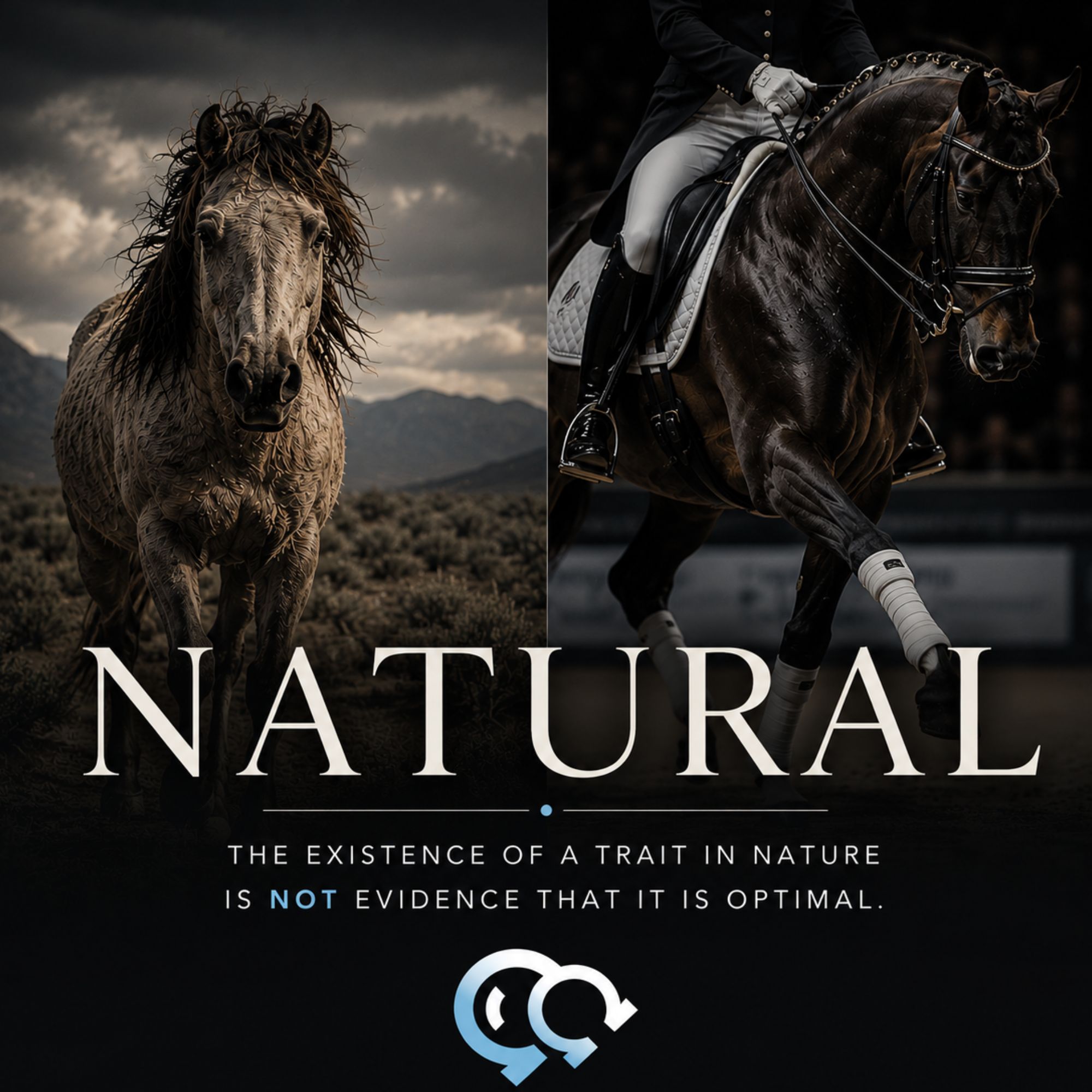
Nature remains an invaluable teacher, but it should not be mistaken for an unquestionable authority. The existence of a trait in nature is not evidence that it is optimal. It is simply evidence that the trait survived.
Our responsibility as practitioners is to ask a more demanding question: not whether an intervention is natural, but whether it improves the comfort, function and welfare of the horse standing in front of us today.
References
- Hampson BA, de Laat MA, Mills PC, Pollitt CC. The feral horse foot. Part A: observational study of the effect of environment on the morphometrics of the feet of 100 Australian feral horses. Aust Vet J. 2013;91(1-2):14-22.
- Hampson BA. The effects of environment on the feral horse foot. Brisbane: University of Queensland; 2011.
- Hampson BA, Ramsey G, Macintosh AM, et al. Morphometry and abnormalities of the feet of Kaimanawa feral horses in New Zealand. Aust Vet J. 2010;88(4):124-131.
- Hampson BA, de Laat MA, Mills PC, Pollitt CC. The feral horse foot. Part B: radiographic, gross visual and histological evaluation of foot health in Australian feral horses. Aust Vet J. 2013;91(1-2):23-30.
- Mellish MA, Stewart K, Contino EK, et al. Visual and morphometric description of feral horse hooves from Sable Island, Nova Scotia, Canada. Can Vet J. 2023;64(10):1001-1008.
- Durham AE, Frank N, McGowan CM, Menzies-Gow NJ, Roelfsema E, Vervuert I, et al. ECEIM consensus statement on equine metabolic syndrome. J Vet Intern Med. 2019;33(2):335-349.