
Equine Hoof Biomechanics: Practical Insights from Uno Yxklinten’s PhD Research ( Cloned )
From Theory to Practice: Applying Hoof Balance Science in Everyday Farriery by Uno Yxklinten’s PhD.
Recent advances in hoof biomechanics have provided a clearer, physics-based definition of what a “balanced hoof” actually means. While some explanations have focused heavily on theory, the real value lies in how farriers can use these insights in daily practice — no radiographs or lab equipment required.
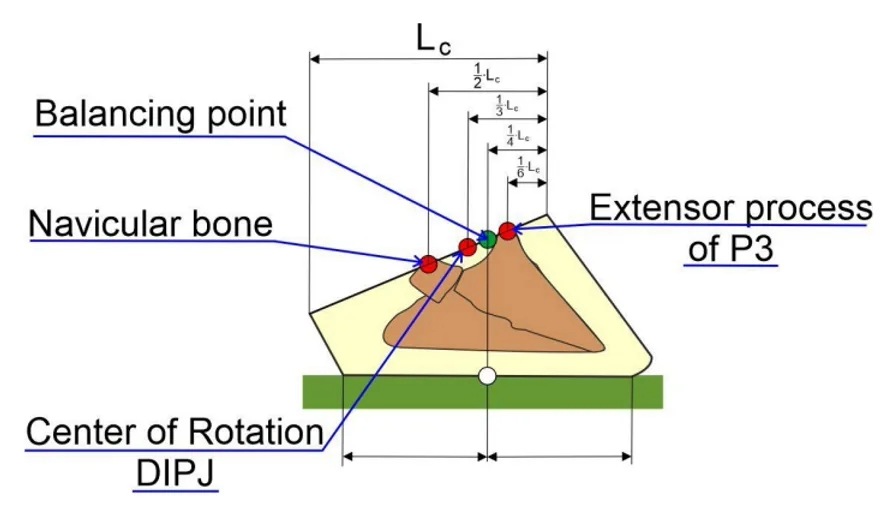
At its core, the research shows that a truly balanced hoof shares weight equally between the toe and heel at mid-stance. This balance point — the Point of Balance (POB) — sits slightly in front of the coffin joint’s centre and can be located externally as a reference about one-quarter of the way back from the toe along the coronet.
The practical takeaway: when trimming or shoeing, aim to centre the base of support around this point. That means setting up the hoof so that the distance from the toe to the POB is roughly equal to the distance from the POB to the end of the heel support. This can be done with your rasp and shoeing tools — no guesswork, just proportion.
By working to this reference, farriers can:
- Reduce excess strain on tendons and joints,
- Improve breakover without forced mechanics,
- And maintain consistent hoof function throughout the shoeing cycle.
In short, this isn’t a new “system” — it’s a practical refinement of what many skilled farriers already aim to achieve. The difference now is that we can explain and apply it with clearer reasoning, rooted in mechanical balance.
For a full no-nonsense practical translation, join me Mark Caldwell, in conversation with Uno Yxklinten on March 12th for tickets, go to
https://www.eventbrite.com/cc/hoofflixcom-myth-busters-3959473?aff=odclrlmcfto