
Equine Hoof Biomechanics: Practical Insights from Uno Yxklinten’s PhD Research
From Theory to Practice: Applying Hoof Balance Science in Everyday Farriery by Uno Yxklinten’s PhD.
Recent advances in hoof biomechanics have provided a clearer, physics-based definition of what a “balanced hoof” actually means. While some explanations have focused heavily on theory, the real value lies in how farriers can use these insights in daily practice — no radiographs or lab equipment required.
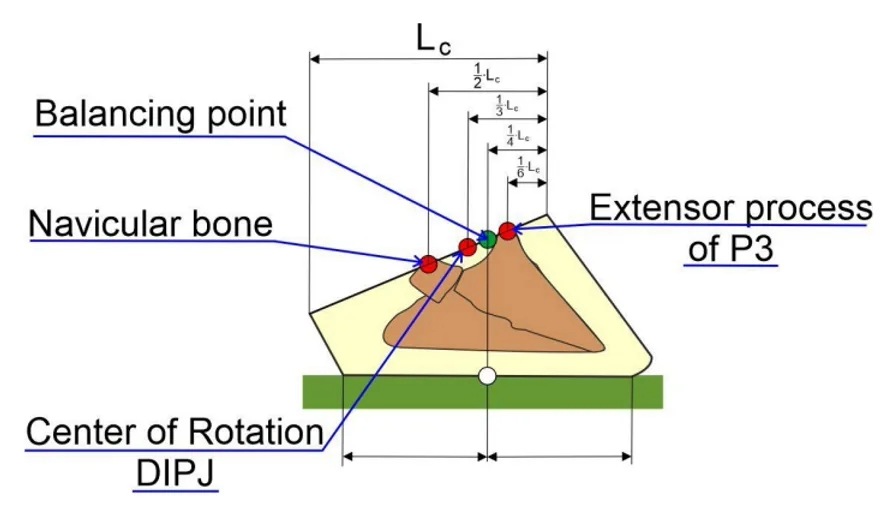
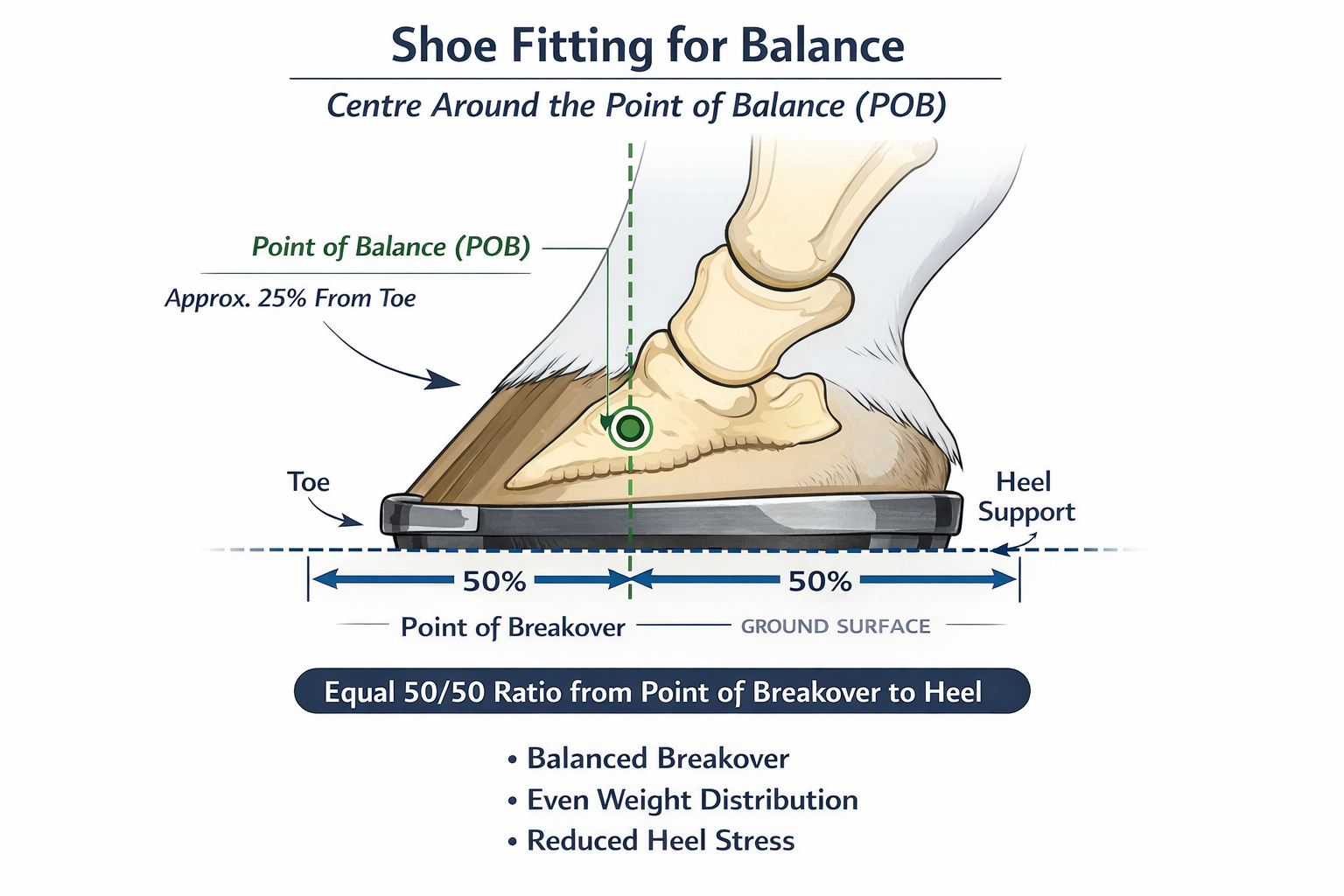
At its core, the research shows that a truly balanced hoof shares weight equally between the toe and heel at mid-stance. This balance point — the Point of Balance (POB) — sits slightly in front of the coffin joint’s centre and can be located externally as a reference about one-quarter of the way back from the toe along the coronet.
The practical takeaway: when trimming or shoeing, aim to centre the base of support around this point. That means setting up the hoof so that the distance from the toe to the POB is roughly equal to the distance from the POB to the end of the heel support. This can be done with your rasp and shoeing tools — no guesswork, just proportion.
By working to this reference, farriers can:
- Reduce excess strain on tendons and joints,
- Improve breakover without forced mechanics,
- And maintain consistent hoof function throughout the shoeing cycle.
In short, this isn’t a new “system” — it’s a practical refinement of what many skilled farriers already aim to achieve. The difference now is that we can explain and apply it with clearer reasoning, rooted in mechanical balance.
For a full no-nonsense practical translation, join me Mark Caldwell, in conversation with Uno Yxklinten on March 12th for tickets, go to
https://www.eventbrite.com/cc/hoofflixcom-myth-busters-3959473?aff=odclrlmcfto
Introduction
Farriery is increasingly informed by science, particularly biomechanics. Uno Yxklinten’s PhD research on equine hoof biomechanics provides valuable scientific insights that can guide farriers in evidence-based hoof care. Multiple studies over the past decades have linked poor hoof balance to lameness and even catastrophic injuries in horses (Snow and Birdsall, 1990; Balch et al., 1993; Kane et al., 1998; Dyson et al., 2011). In particular, imbalances in the hoof’s dorso-palmar (toe-to-heel) orientation have been associated with specific pathologies: poor toe–heel balance is implicated in navicular syndrome of the front feet (Waguespack and Hanson, 2010; 2011), and long-toe, low-heel conformation in the hinds has been correlated with hindlimb pain and lameness (Mansmann et al., 2010; Pezzanite et al., 2019; Clements et al., 2020). Despite these known links, farriers have long debated what actually constitutes a “balanced” hoof and how to achieve it consistently. Yxklinten’s research tackles this question by applying classical mechanics to the equine foot, leading to a new hoof balance paradigm that has practical applications in trimming and shoeing.
Traditional Concepts of Hoof Balance
For generations, farriers and researchers have proposed guidelines to attain a balanced hoof. As far back as 1903, William Russel emphasised creating correct hoof proportions to reduce injury risk (Russel, 1903/1988). Russel suggested using the hoof’s center of gravity as a reference point for shoe placement, aiming for symmetry around that point. In the late 20th century, farrier Dave Duckett introduced the idea that understanding internal anatomy is key to balance (Duckett, 1990). Duckett identified two external reference landmarks on the hoof: Duckett’s Dot (located roughly over the extensor process of the coffin bone) and Duckett’s Bridge (an area corresponding to the center of the weight-bearing surface). He proposed that in a perfectly balanced bare foot, the distance from the bridge to the toe should equal the distance from the bridge to the heels – effectively dividing the hoof’s weight-bearing length into equal halves (Duckett, 1990). This proportional balance was thought to place the hoof’s center of rotation (COR) in the middle of the weight-bearing surface, aligning with a natural breakover point for optimal biomechanics. Duckett’s Dot was even described as the hoof’s “balance point” – supposedly coincident with the center of pressure of the hoof during weight-bearing – and the ideal location around which to balance the foot.
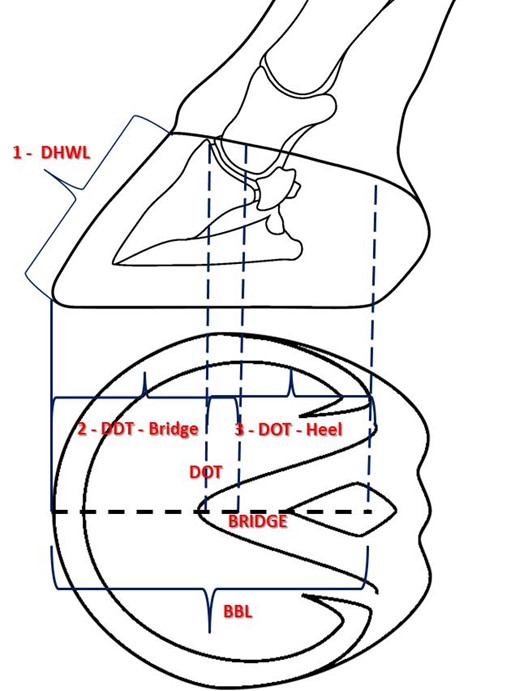
1990 external reference points Duckett’s “Dot” and Duckett’s “Bridge”. Duckett suggested that to achieve static foot balance three measurement indicators: (1) dorsal hoof wall length (DHWL), (2) the distance from the dorsodistal tip of the toe (DDT) to the widest point of the bearing border (DDT – Bridge) and (3) the distance from a point 9.5mm palmar of the frog apex (DOT) to the widest point of the frog (DOT-Heel) were equivalent. (Reproduced with permission of D. Duckett FWCF).
Subsequent literature embraced these geometric notions. Farriers widely teach that the shoe or hoof should be trimmed such that the distal interphalangeal joint’s COR lies at the midpoint of the hoof’s base, yielding a 50:50 front-back ratio. Research has supported that proportional trimming around the COR correlates with efficient biomechanics in many cases (Caldwell et al., 2016). For example, Caldwell and colleagues (2016) found that an external reference point corresponding to the joint’s center can serve as a reliable guide to internal alignment, lending theoretical support to the 50:50 balance concept. Other practitioners added refinements: Jim Ferrie described a method to locate the COR from a lateral (side) radiograph of the foot, reinforcing the importance of symmetry around that point (Ferrie, 2007). More recently, studies by Henry Berger (FWCF thesis, 2017) and Gavin Moon (FWCF thesis, 2019) tested the accuracy of external landmarks for internal structures. Moon (2019) noted that while aiming for a 50:50 ratio around the COR is biomechanically sound in theory, it may be impractical to achieve perfectly in every case. Instead, Moon suggested using the center of the coffin bone’s articulating surface as a more attainable reference in shoeing, since it might better reflect the functional mechanics of the foot in practice (Moon, 2019).
These traditional and modern insights all indicate that proportions of the hoof matter for its mechanics, and that balance is achieved when certain length ratios are met (Duckett, 1990; Caldwell et al., 2016; Moon, 2019). However, it’s important to note that until recently, few of these approaches explicitly quantified why those proportions work – that is, the physics and force distribution that make a hoof “balanced.” Duckett’s Dot was assumed to coincide with the center of pressure (COP) of the ground reaction force, but recent evidence has questioned this assumption. Caldwell’s studies found that the hoof’s actual center of pressure during stance does not necessarily line up with the extensor process of the coffin bone (Caldwell, 2017). Moreover, many researchers now recognize the COP as a dynamic point that shifts during the stride (van Heel et al., 2004; van Heel et al., 2005; Moleman et al., 2006). In other words, the point of peak pressure under the hoof moves as the horse’s weight loads and unloads the limb, rather than being fixed at one anatomic landmark. This evolving understanding set the stage for Yxklinten’s work, which sought to fully integrate the physics of forces and torques into the definition of hoof balance.
A New Hoof Balance Paradigm at Mid-Stance
The quantification and definition of a new hoof balance paradigm
Uno Yxklinten, together with collaborator Yogi Sharp, proposed a fresh way to define and achieve hoof balance based on mechanics at mid-stance. Their research introduced the concept of a Point of Balance (POB) – a specific point located anterior to the distal interphalangeal joint’s center of rotation, roughly midway between the joint’s center and the tip of the coffin bone (Yxklinten and Sharp, 2023). In practical terms, this point can be found about one-quarter of the distance along the coronary band from the dorsal (front) hoof wall. The POB represents a theoretical “balancing point” of the hoof in the dorso-palmar direction (front-to-back). At mid-stance (when the hoof is fully loaded on the ground and the limb is vertical), aligning the hoof around this point ensures that forces are evenly distributed.
Crucially, Yxklinten’s model defines what a balanced hoof is in measurable terms. A balanced equine hoof is one in which the ground reaction force is evenly spread across the solar surface, and the center of pressure of that force lies directly beneath the limb’s axis at mid-stance. In other words, when the horse’s weight is borne on the hoof, neither the toe nor the heel (nor one side of the hoof) is taking a disproportionate load – the forces are in equilibrium. Achieving this requires that the vertical line of force from the limb passes through the hoof at the POB. If the hoof is trimmed and shod such that this condition occurs at mid-stance, the result is a uniform pressure distribution over the hoof’s solar area. Yxklinten’s analysis using free-body diagrams and force vectors showed that placing the POB correctly yields zero net torque on the hoof at mid-stance – a state of equilibrium (Crandall et al., 1978).
In practice, how can farriers use this paradigm? The researchers suggest a straightforward protocol: balance the hoof by creating equal toe and heel length around the POB. Specifically, if one drops an imaginary vertical line from a point about 25% of the way back from the toe along the coronet (the hairline), that line should intersect the weight-bearing surface at the hoof’s “pressure center.” Trimming or shoeing to achieve roughly 50/50 proportional length of the foot in front of and behind that line will align the hoof’s effective center of pressure under the limb (Caldwell et al., 2016; Yxklinten and Sharp, 2023). In doing so, the farrier is essentially lining up the hoof’s load such that the pressure point of the hoof’s solar surface sits directly below the POB. According to the new definition, this is a balanced hoof – the hoof capsule and bony column are working harmoniously, with forces evenly shared.
Dynamics of Hoof Balance Over the Shoeing Cycle
Yxklinten’s work also sheds light on how hoof balance changes over time, especially across a shoeing or trimming cycle. Earlier studies using pressure plates demonstrated that the hoof’s center of pressure tends to move caudally (toward the heels) as weeks go by after shoeing (van Heel et al., 2005; Moleman et al., 2006). For instance, van Heel and co-workers (2005) observed that after an 8-week shoeing interval, the COP at mid-stance had shifted significantly backward, increasing the load on the heels and the bending moment around the coffin joint. This finding aligns with common farrier intuition that hooves left too long between trims end up “long in the toe” and strain the back of the foot.
Interestingly, some theoretical models had predicted the opposite – suggesting a dorsal migration of the point of force application as the toe grows (Wilson and Weller, 2011). This contradiction created confusion in the farriery community about what really happens to hoof balance as the foot grows out. Yxklinten’s analysis provides an explanation that reconciles these views. Using the new model’s terminology: on a hard, non-deformable surface, the ground reaction force will act in line with the POB when the hoof is balanced. As the toe grows longer over a shoeing cycle, the hoof’s pressure point on the ground (the area of highest pressure on the solar surface) actually moves forward relative to the coffin joint. The POB, however, remains at the same location on the hoof (since it’s tied to anatomy). Consequently, with an overgrown toe, the situation at mid-stance is that the limb’s force is still coming down through POB (farther back relative to the toe), but the hoof’s contact pressure point has shifted forward toward the toe. This makes it appear as if the ground reaction force’s COP has migrated backward (because the hoof effectively moved forward around the force). In simpler terms, as the toe gets long, the hoof’s balance point and the actual center of pressure drift apart, leading to more weight borne by the heels. Yxklinten’s model clarifies that both descriptions were measuring the same imbalance from different perspectives: on hard ground, the limb’s force line stays near POB (so the hoof seems to slip backward under it), whereas on softer ground the toe might dig in and alter the apparent pressure distribution less. Either way, the takeaway is that hoof balance is time-dependent – it progressively changes as the hoof grows, underscoring the importance of regular maintenance to keep the forces optimized.
One practical concept introduced is a “balance zone” in the hoof. Yxklinten suggests that ideally, throughout the shoeing cycle, the hoof’s base of support should remain proportionally around a zone between the extensor process of P3 (coffin bone) and the joint’s center of rotation. If the toe grows beyond this zone, the hoof moves out of balance as defined by the model. This provides farriers and veterinarians a more dynamic understanding: balance is not a one-time achievement but something that drifts, and trimming/shoeing resets the hoof into balance. By defining the POB and related points, the model brings clarity to how the physical forces shift during the cycle. It creates a framework to discuss when a foot is due for trimming based on physics, not just appearance or time interval.
Applications in Farriery Practice
Translating these biomechanical insights into hoof-care practice has several implications. Firstly, the new paradigm gives farriers a clear target for trimming and shoe placement: line up the shoe and hoof capsule around the POB at the time of shoeing. In a hoof with normal conformation, this means the trimmed foot will have roughly equal length in front of and behind a point one-quarter of the hoof’s length from the toe (on the coronet). Following this guideline should result in the horse’s weight being distributed evenly, which can improve the efficiency of movement and potentially reduce strain on structures like the navicular bone and deep flexor tendon. Essentially, the farrier can use the quarter-from-toe landmark as a quick check for balance in the dorso-palmar plane. This is a more physics-based criterion than some traditional rules (like the 3:1 hoof-pastern ratio), and it’s easily observable once one knows where to look.
Secondly, Yxklinten’s model can help in diagnosing and correcting imbalances. If a hoof is not balanced (for example, a long toe/low heel configuration), the model predicts that the vertical force line from the limb will miss the hoof’s pressure center, causing one part of the foot to be overloaded. A farrier can infer which structures might be under excess strain: a long-toe hoof tends to overload the heels and strain the navicular area, whereas a mismatched hoof-pastern axis might shift pressure abnormally (Mansmann et al., 2010; Ruff et al., 2016). By understanding the distribution of forces, farriers can tailor their trimming or shoeing – for instance, rockering or rolling the toe to bring the breakover back under POB, or using wedge pads to correct a collapsed heel so that the limb’s force is realigned through the hoof’s center. Yxklinten’s qualitative analysis provides a basis to anticipate how certain shoeing changes (such as different shoe types or orthotics) will affect the load. Indeed, the research indicates that applying different shoes (steel vs. polymer, wedges, etc.) will alter the hoof’s pressure point and hence the balance, but these effects can be mapped using the same principles. This opens the door to a more predictive farriery – using simple mechanical models to foresee how a given change will redistribute forces in the foot.
Finally, the research offers a new definition of “balanced hoof” that can unify communication among professionals. By moving beyond purely geometric descriptions, farriers and veterinarians can discuss balance in terms of equilibrium of forces at mid-stance. This is a more objective language. It reinforces that farriery is not just an art but also a science grounded in biomechanics. As Dr. Simon Curtis famously noted:
“There is often a belief that foot balance and farriery in general are not scientific; that it is an art and cannot be quantified. This view suits most observers of farriery, not least the farriers themselves. Farriery may not have been defined by strict rules that can be applied universally, but this does not mean that it is not a science; it only means that it has yet to be defined. The forces (both natural and induced) that affect the equine foot are not divorced from those that govern the rest of the universe. We should view farriery as having almost infinite variations, all of which have recognizable patterns that can be predicted. In the same way, in tennis, no two shots are identical but they are still governed by the laws of physics.” (Curtis, 2006, p.106)
Yxklinten’s work is a step toward that quantification of farriery. By defining a balance point and backing it with mechanical analysis, it provides a concrete rule grounded in physics. For farriers, this means hoof balance can be assessed and achieved with more confidence. Over time, such evidence-based approaches should improve hoof-care outcomes, reducing injury risk and enhancing equine performance.
Conclusion
Uno Yxklinten’s PhD research on hoof biomechanics introduces a compelling paradigm that balances the equine hoof at mid-stance using principles of classical mechanics. In summary, the Point of Balance (POB) — located about a quarter of the distance from the toe along the coronet — is proposed as the hoof’s true balancing point. When the hoof is trimmed or shod so that the weight is evenly distributed around this point, the forces and torques within the foot reach equilibrium at mid-stance. This state of balance can be observed as an equal loading of the toe and heel, and it maximizes biomechanical efficiency while minimizing undue stress on any one structure. Importantly, Yxklinten’s model acknowledges that hoof balance is not static: as the hoof grows out between farriery visits, the balance shifts, underscoring the need for regular, individualized trimming intervals. The applications of these findings in farriery are practical and immediate — from using the POB as a quick field reference for balance, to designing shoeing interventions that account for changes in force distribution. In an industry where tradition often meets innovation, this research bridges the two by providing a scientific basis for age-old farriery principles. Ultimately, embracing such biomechanical insights allows hoof-care professionals to refine their craft, ensuring healthier hooves and sounder horses.
References (Harvard Style)
Balch, O., White, K., and Butler, D. (1993). How lameness is associated with selected aspects of hoof imbalance. Proceedings of the American Association of Equine Practitioners, 39, 213–214.
Berger, H. (2017). Use of external landmarks as the reference point for the location of internal structures within the hoof capsule. FWCF Thesis.
Caldwell, M.N., Allan, L.A., Pinchbeck, G.L., Clegg, P.D., Kissick, K.E., and Milner, P.I. (2016). A test of the universal applicability of a commonly used principle of hoof balance. The Veterinary Journal, 207, 169–176.
Caldwell, M.N. (2017). An investigation into the use of hoof balance metrics to test the reliability of a commonly used foot trimming protocol and their association with biomechanics and pathologies of the equine digit. PhD thesis, University of Liverpool.
Clements, P.E., Handel, I., McKane, S.A., and Coomer, R.P. (2020). An investigation into the association between plantar distal phalanx angle and hindlimb lameness in a UK population of horses. Equine Veterinary Education, 32(S10), 52–59.
Curtis, S. (2006). Corrective Farriery: Volume I, p.106. Newmarket: Published by the author.
Duckett, D. (1990). The assessment of hoof symmetry and applied practical shoeing by use of an external reference point. In Proceedings of Farriery and Lameness Seminar, Newmarket, 2(suppl.), 1–11.
Dyson, S.J., Tranquille, C.A., Collins, S.N., Parkin, T.D.H., and Murray, R.C. (2011). External characteristics of the lateral aspect of the hoof differ between non-lame and lame horses. The Veterinary Journal, 190(3), 364–371.
Ferrie, J. (2007). Shoeing around the coffin joint. Forge and Farrier [online article]. (Available at: Forge & Farrier website, accessed Oct 2021).
Kane, A.J., Stover, S.M., Gardner, I.A., Bock, K.B., Case, J.T., Johnson, B.J., et al. (1998). Hoof size, shape and balance as possible risk factors for catastrophic musculoskeletal injury of Thoroughbred racehorses. American Journal of Veterinary Research, 59, 1545–1552.
Mansmann, R.A., James, S., Blikslager, A.T., and vom Orde, K. (2010). Long toes in the hind feet and pain in the gluteal region: An observational study of 77 horses. Journal of Equine Veterinary Science, 30(12), 720–726.
Moleman, M., van Heel, M.C.V., van Weeren, P.R., and Back, W. (2006). Hoof growth between two shoeing sessions leads to a substantial increase of the moment about the distal (but not the proximal) interphalangeal joint. Equine Veterinary Journal, 38(2), 170–174.
Moon, G. (2019). Hoof mapping – guide or rule? The accuracy of external landmarks to localize internal structures in the equine hoof. FWCF Thesis.
Ovnicek, G. (2003). Natural balance trimming and shoeing: appearance of a self maintained foot. In: Ross, M.W. and Dyson, S.J. (eds.), Lameness in the Horse. St. Louis: W.B. Saunders, pp. 271–273.
Pezzanite, L., Bass, L., Kawcak, C., Goodrich, L., and Moorman, V. (2019). The relationship between sagittal hoof conformation and hindlimb lameness in the horse. Equine Veterinary Journal, 51(4), 464–469.
Russel, W. (1903; reprinted 1988). Scientific Horseshoeing. 10th edition. (Original work published 1903).
Snow, V. and Birdsall, D. (1990). Specific parameters used to evaluate hoof balance and support. Proceedings of the American Association of Equine Practitioners, 36, 299–311.
Turner, T.A. (1992). The use of hoof measurements for the objective assessment of hoof balance. Proceedings of the American Association of Equine Practitioners, 38, 389–395.
van Heel, M.C.V., Barneveld, A., van Weeren, P.R., and Back, W. (2004). Dynamic pressure measurements for the detailed study of hoof balance: The effect of trimming. Equine Veterinary Journal, 36, 778–782.
van Heel, M.C.V., van Weeren, P.R., and Back, W. (2005). Changes in location of center of pressure and hoof-unrollment pattern in relation to an 8-week shoeing interval in the horse. Equine Veterinary Journal, 37, [pagination unknown].
Waguespack, R.W. and Hanson, R.R. (2010). Navicular syndrome in equine patients: Anatomy, causes, and diagnosis. Compendium: Continuing Education for Veterinarians, 32(12).
Waguespack, R.W. and Hanson, R.R. (2011). Treating navicular syndrome in equine patients. Compendium: Continuing Education for Veterinarians, 33(1).
Wilson, A.M. and Weller, R. (2011). The biomechanics of the equine limb and its effect on lameness. In: Ross, M.W. and Dyson, S.J. (eds.), Diagnosis and Management of Lameness in the Horse, 2nd edition. St. Louis: Elsevier, pp. 270–281.