
Comparing Hoof Balance Theories: Duckett, Caldwell and Yxklinten
Introduction
Hoof balance is a fundamental concern in farriery and equine podiatry. Imbalances in the hoof have long been linked to lameness and even severe injury in horses. Yet, despite general agreement that “balance” is critical, professionals often debate what precisely constitutes a balanced hoof. Over the years, several theories and methods have emerged. This article compares three influential approaches to hoof balance: the classic landmarks introduced by David Duckett, the evidence-based insights from research by Mark Caldwell, and the recent mathematical model proposed by Dr Uno Yxklinten. Although differing in methodology, all three aim to optimise the hoof’s form to improve biomechanics and reduce injury risk. Understanding their commonalities and differences can help farriers and veterinarians make informed decisions in practice.
Duckett’s Hoof Balance Theory
British farrier David Duckett is renowned for introducing a practical system of external reference points to evaluate hoof balance. In 1990, Duckett identified two key landmarks on the foot: “Duckett’s Dot” and “Duckett’s Bridge.” The Dot corresponds to the extensor process of the coffin bone (the distal phalanx) – essentially aligning with the tip of the pedal bone and the intersection of the hoof’s main tendon forces. Duckett described this Dot as the balance point of the distal phalanx and approximately the centre of pressure of the hoof. The Bridge, on the other hand, is located at the widest part of the hoof’s solar surface (around the frog’s apex region). Notably, this Bridge closely matches what earlier farriers like Russell called the hoof’s “centre of gravity.”
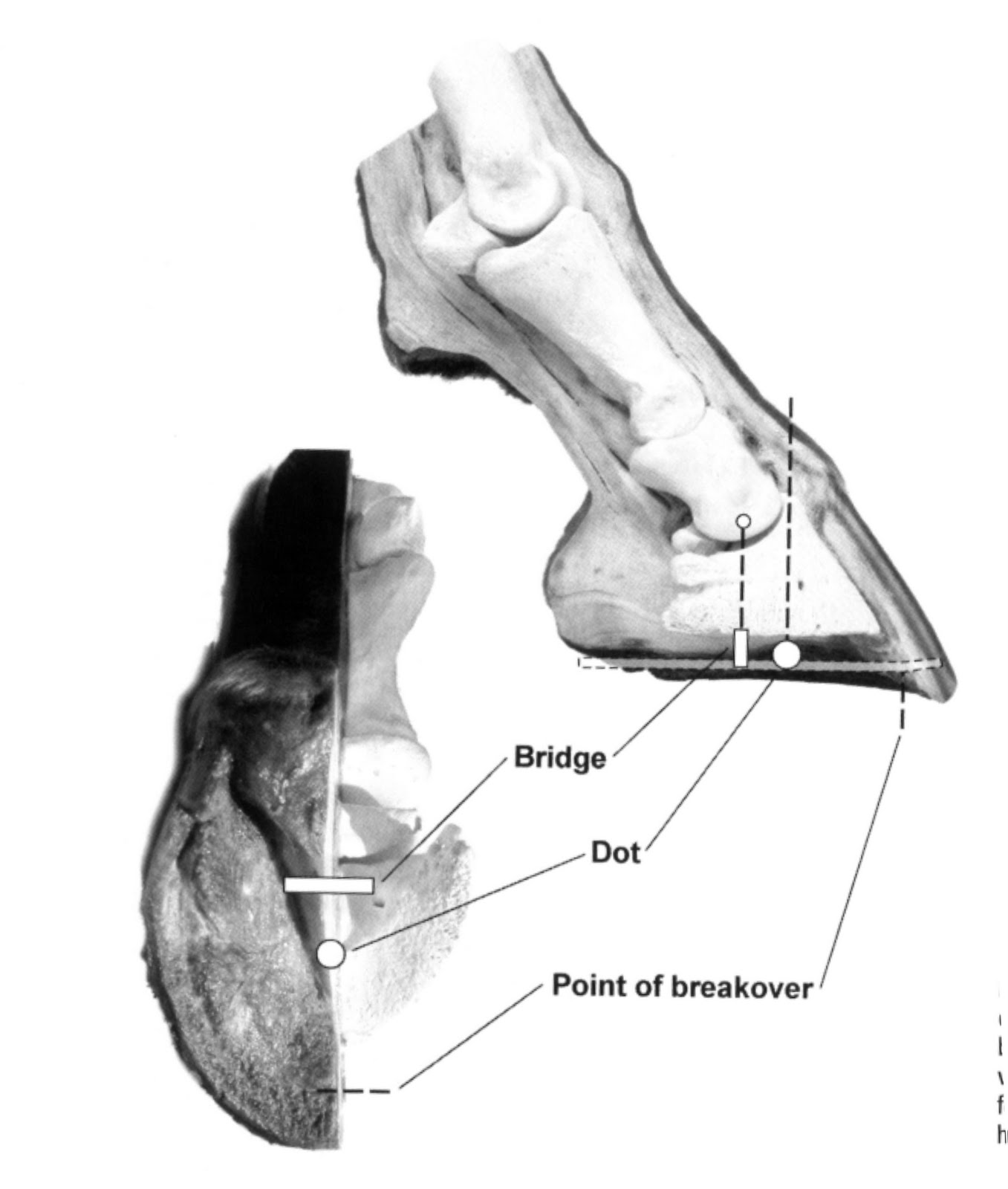
Ducketts’ 1990 points of reference the DOT and Bridge . photo Fran Jurga
Duckett’s theory asserted that a hoof is in static balance when its weight-bearing length is evenly distributed around the Bridge. In practice, this means the distance from the back of the hoof (heel buttress) to the Bridge should equal the distance from the Bridge to the toe. In a well-proportioned barefoot hoof, Duckett noted that these distances also mirror the toe length. By trimming to achieve these equal proportions, the farrier positions the hoof’s effective centre (and the coffin joint’s centre of rotation) roughly in the middle of the foot. Duckett suggested that if one were to draw an arc from the heel to the toe with its centre at the coffin joint, it would intersect the toe at the natural breakover point – an optimal position for efficient breakover and load distribution. When applying a horseshoe, Duckett similarly recommended setting the shoe so that the length of the shoe extending behind the Bridge equals the length in front (meaning the breakover point of the shoe is equally distant from the Bridge as the heels are). This approach was one of the first to link external hoof trimming guides with the hoof’s internal anatomy. It gave farriers a tangible “map” for balance, and it remains widely taught. However, while the Duckett’s Dot and Bridge system provides clear guidelines, it is essentially geometric and static in nature – based on idealised proportions of a healthy foot at one moment in time.
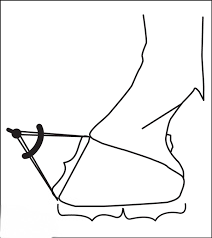
Duckett’s 1990 concept of proportional hoof balance around his reference point of Ducketts’ Bridge assumes a 2:1 ratio of DHWL with Bearing Border.
Caldwell’s Evidence-Based Perspective
Mark Caldwell, a farriery educator and researcher, built upon and tested these traditional balance principles through scientific study. In 2016, Caldwell and colleagues published research that examined the “universal applicability” of a commonly used hoof balance principle – namely, the idea of equal proportions around the centre of the foot. Caldwell’s team introduced a mapping protocol to locate an external centre of rotation (eCoR) on the hoof, which corresponds to the internal centre of rotation of the coffin joint. This external CoR is essentially an anatomical guideline similar to Duckett’s Bridge (in fact, Caldwell found that the eCoR aligned closely with Duckett’s described Bridge location). Using this point as a reference, the traditional goal has been to have roughly 50% of the hoof (or shoe) in front of the point and 50% behind it, thereby centring the load around the joint’s axis. Caldwell’s work confirmed some key aspects of Duckett’s concept: the eCoR method correlates well with internal anatomy, and trimming/shoeing to achieve equal distances around that point is supported by many as biomechanically sound. Indeed, positioning the shoe such that the distal interphalangeal joint’s centre of rotation ends up near the middle of the foot is widely accepted as good practice for efficiency of movement and reducing undue stress on any one part of the hoof.
However, Caldwell’s research also provided a reality check. By measuring numerous horses, the study revealed significant natural variation in hoof proportions and questioned whether a strict 50:50 ratio around the centre is attainable (or necessary) for every horse. In other words, while the balanced ideal (equal toe and heel support relative to the joint) is theoretically optimal, many hooves in real-world conditions deviate from this symmetry. Factors like individual conformation, hoof shape, and growth between shoeing cycles mean that not all hooves will match a perfect geometric template at all times. Caldwell’s findings have been interpreted by some in the industry as an argument that one should be careful about applying universal rules of balance. The take-home message is that hoof balance may not be a one-size-fits-all equation. Some horses naturally have slightly different proportions, and forcing a hoof to fit an ideal template without regard for its internal structures or past pathologies could be counterproductive. Caldwell and others emphasize an “evidence-based farriery” approach: use tools (like mapping the eCoR or taking measurements) to inform trimming, but also pay close attention to the horse’s movement, hoof growth patterns, and comfort over time. If a foot is kept functionally balanced (even if it isn’t a perfect 50:50 by measurement), that may be more important than chasing an exact number. In summary, Caldwell’s perspective doesn’t discard the value of Duckett’s reference points, but it tempers it with scientific data, suggesting that individual variation and dynamic changes over time must be considered when assessing balance.
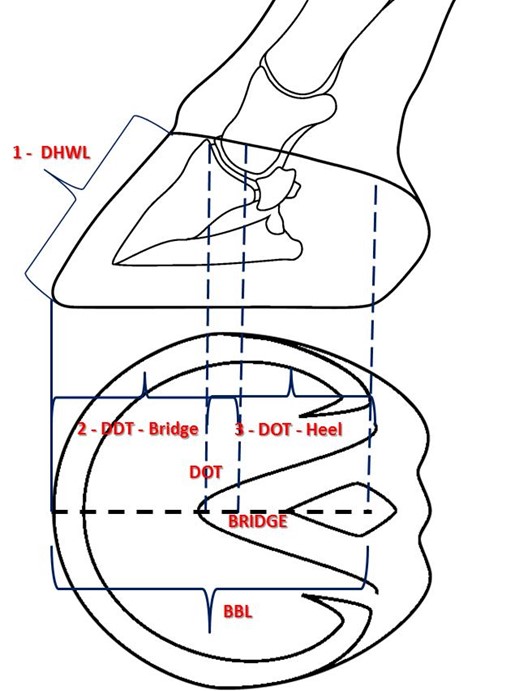
Caldwell’s findings suggest an inverse relationship in form based on the proportional measurement of Ducketts’ DOT to Bridge. (Caldwell 2017)
Yxklinten’s Point of Balance (PoB) Model
While Duckett’s and Caldwell’s approaches focus on anatomical landmarks and proportions, Dr Uno Yxklinten (a Swedish researcher) has recently proposed a fresh model of hoof balance rooted in physics and mathematics. Working with farrier and author Yogi Sharp, Yxklinten set out to define an ideal balance point based on force distribution in the shod hoof. The resulting concept is known as the Point of Balance (PoB) theory, and it represents a new hoof balance paradigm aimed at optimising how the hoof bears weight during motion.
Rather than starting with anatomy and assuming equal proportions yield balance, Yxklinten’s method starts with the desired outcome: a balanced hoof, in their definition, is one that experiences equal ground reaction force between the toe half and heel half of the foot at mid-stance. Mid-stance is the phase of the stride when the hoof is fully loaded on the ground with the horse’s weight passing over it. If the toe region and the heel region are carrying the same amount of force at that moment, the hoof is in equilibrium – neither the toe diving down nor the heels sinking excessively. Through mathematical modelling of the hoof under load, Yxklinten’s study identified a specific point on the hoof’s circumference around which this equilibrium occurs. This Point of Balance (PoB) is located approximately one-quarter of the length of the hoof’s coronet (hairline) measured from the dorsal toe. In practical terms, it lies a bit forward of the coffin joint’s centre of rotation, roughly between the dorsal extensor process of the coffin bone and the joint centre.
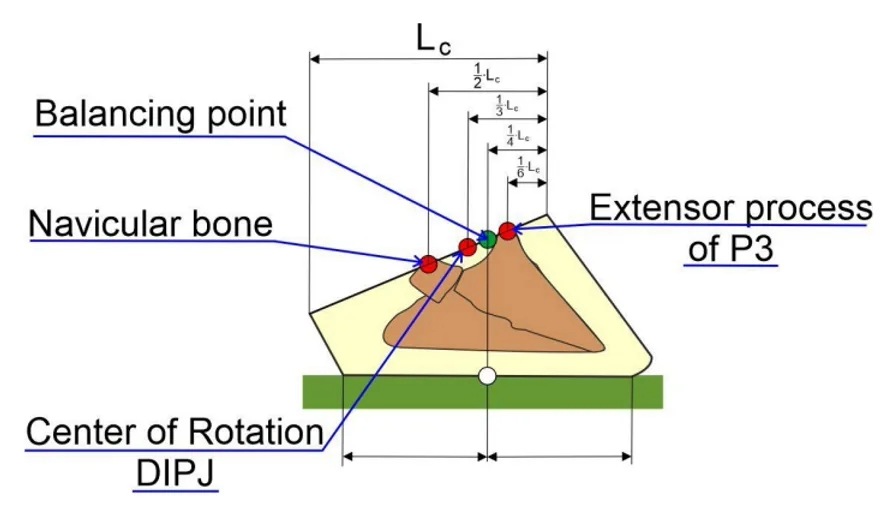
The quantification and definition of a new hoof balance paradigm
Using the PoB as the reference, the goal is to trim or shoe the hoof so that the ground-contact area is evenly distributed around that point. This effectively means equalising the toe and heel support around the PoB, rather than around the traditional centre of the foot. Achieving this at the time of shoeing would, according to the model, produce that ideal mid-stance equilibrium – the hoof would load evenly front and back when the horse bears weight on soft ground. The PoB is a calculated point tied to the physics of weight distribution, not a fixed anatomical landmark like Duckett’s Dot. It shifts slightly with changes in hoof shape and orientation. Because hooves grow and their form changes between farrier visits, Yxklinten and Sharp acknowledge that maintaining perfect equilibrium is a moving target. They suggest that instead of focusing on a single static point, farriers should think in terms of a “balance zone.” In practice, there is a tolerable range around the PoB within which the hoof will remain effectively balanced throughout the shoeing cycle. As the weeks go by and the toe grows out or the heels change, the hoof’s proportions will shift, but if they remain within that zone of balance, the distribution of forces stays close to even. By the next trim, the farrier can reposition the balance into the ideal range again.
The PoB model is innovative because it marries the concept of proportional trimming to a tangible mechanical outcome (force equilibrium). It essentially refines the old idea of 50:50 balance by specifying what should be 50:50 – not just hoof length, but the forces experienced by the foot. It also implicitly underscores the importance of hoof-pastern alignment: if the bones in the limb are misaligned (for example, a long-toe/low-heel hoof creating a broken-back pastern axis), the distribution of forces and the PoB will be affected. Achieving equilibrium may require addressing those alignment issues as well. In summary, Yxklinten’s approach offers a more dynamic way to define balance, potentially guiding farriery toward optimizing how the hoof functions under the horse’s weight, rather than focusing purely on static measurements.
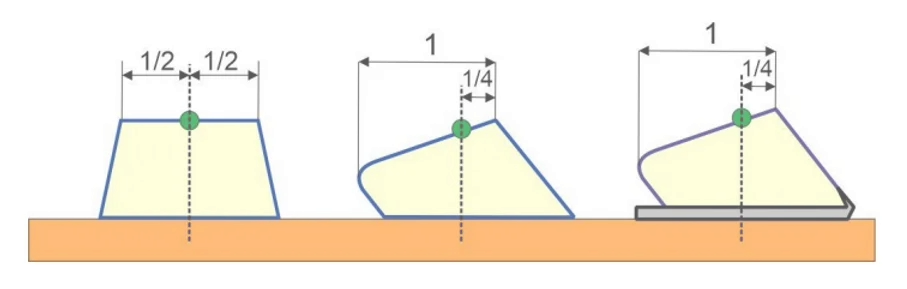
Point of balance. The symmetric hoof from in front and the symmetry line (dashed line) through the hoof and the point of action of the force from the leg (left), POB (green dot). In the middle and to the right the lateral views of the hoof (unshod and shod) are shown, and POB is again marked with a green dot (1/4 of the coronet’s length from the dorsal part of the hoof capsule).